
Live Streaming Costs in 2026: How Much Does a Professional Livestream Cost?
From lecture streams to hybrid events with redundancy: realistic prices, transparent cost factors—and why cheap streams can end up being expensive.
Reading time: 10 minutes | Updated: July 2026
You want to stream your event live online—the town hall meeting for all locations, the industry conference with an online audience, the annual shareholders’ meeting. And the first question in the project meeting is: How much will it cost? Answers on the market range from “starting at 500 euros” to “five figures,” which doesn’t help you much when planning your budget.
We’ve been producing livestreams and hybrid events in the Rhine-Main region for years—from corporate town halls to public events. Here, you’ll find the figures you need for sound planning, as well as the cost factors that truly explain a quote.
The short answer: Live streaming costs at a glance
In 2026, a professional livestream will cost between 1,500 and 15,000 euros. A simple lecture stream with one camera costs between 1,500 and 2,500 euros. The standard package—two to three cameras, live production, graphics, and professional sound—costs between 3,500 and 8,000 euros. Hybrid events and annual shareholder meetings with redundancy technology range from 8,000 to 15,000 euros, while multi-day trade show and event productions cost even more.
Live Streaming Costs: The Price Chart
Realistic price ranges for professional livestream productions in Germany:
| Budget | Format | What You Get |
|---|---|---|
| 1,500–2,500 euros | Basic | Presentation or webinar, 1 camera, audio recording, streaming to a platform |
| 3,500–8,000 euros | Standard | Podium/Town Hall, 2–3 cameras, live production with video switcher, on-screen captions, video clips, recording |
| 8,000–15,000 euros | Premium | Hybrid event or annual shareholders’ meeting, 3–5 cameras, redundancy (backup encoder, bonding), audience interaction, dress rehearsal |
| 15,000+ euros | Enterprise | Multi-day conference, trade show studio, multilingual streams, custom set design, production team |
How much will your project cost, specifically?
Tell us briefly what you have in mind—during the free initial consultation, you’ll receive an honest assessment with no obligation.
Call now: +49 611 900 67 225 Send a WhatsApp messageAll prices are net; these are approximate rates for one-day productions, including setup and takedown.
The 6 Cost Factors in Live Streaming
1. Cameras and Live Production
Every additional camera means more angles—and more staff, signal paths, and production effort. One camera is enough for a lecture. For a panel discussion or larger event, you’ll need at least two—preferably three—angles, plus a video switcher, to keep the stream engaging so viewers don’t tune out after five minutes.
2. Staff on the day of the event
A livestream is like live television on a smaller scale: camera operators, video mixers, sound engineers, and streaming operators. Unlike on a film set, there’s no second take—the team has to get it right the first time. A standard setup involves three to five people, including setup starting early in the morning.
3. Internet Connectivity and Redundancy
The underestimated factor. A stable stream requires a guaranteed upload—home networks at event venues are often not designed for this. Professional productions use dedicated lines or LTE/5G bonding, which bundles multiple cellular connections. This comes at a cost, but it prevents the worst-case scenario: a frozen stream in front of 500 viewers.
4. Streaming Platforms and Data Protection
YouTube and Vimeo are quick to set up—but they aren’t suitable for every use case. Internal town hall meetings with sensitive content require access-restricted, GDPR-compliant platforms hosted in Europe. Password protection, individual access links, or integration with your intranet are additional features that should be included in the proposal.
5. Graphics, video clips, on-screen captions
Name banners, program guides, intermission loops, pre-produced video segments: These elements turn a filmed event into a broadcast. They are produced before the event and played back in the live control room—costing anywhere from a few hundred to several thousand euros, depending on the scope.
6. Rehearsals and Dress Rehearsal
For critical events—such as annual shareholder meetings, executive board communications, and public events—a dress rehearsal covering the entire signal path is standard practice. It takes half a day to a full day of additional technical setup time and is the most cost-effective safeguard against technical glitches.
Common Formats — and What They Realistically Cost
Internal Town Hall (€3,500–6,000)
Management addresses all locations: 2 cameras, integration with presentations, a restricted-access platform, and recording for the intranet. This is the most common use case for small and medium-sized businesses.
Symposium & Panel Discussion (€4,000–8,000)
Multiple speakers, audience questions from the chat, a program lasting several hours. This is where directing experience counts: whoever is speaking is on screen—without any frantic cuts.
Annual Shareholders’ Meeting & Investor Relations (€8,000–15,000)
Legally compliant transmission with redundancy at all levels, integration of synchronization, and backup lines. The rule here is: A failure is not just a glitch, but a compliance issue. Accordingly, dual systems are a must.
Hybrid Event (€6,000–15,000)
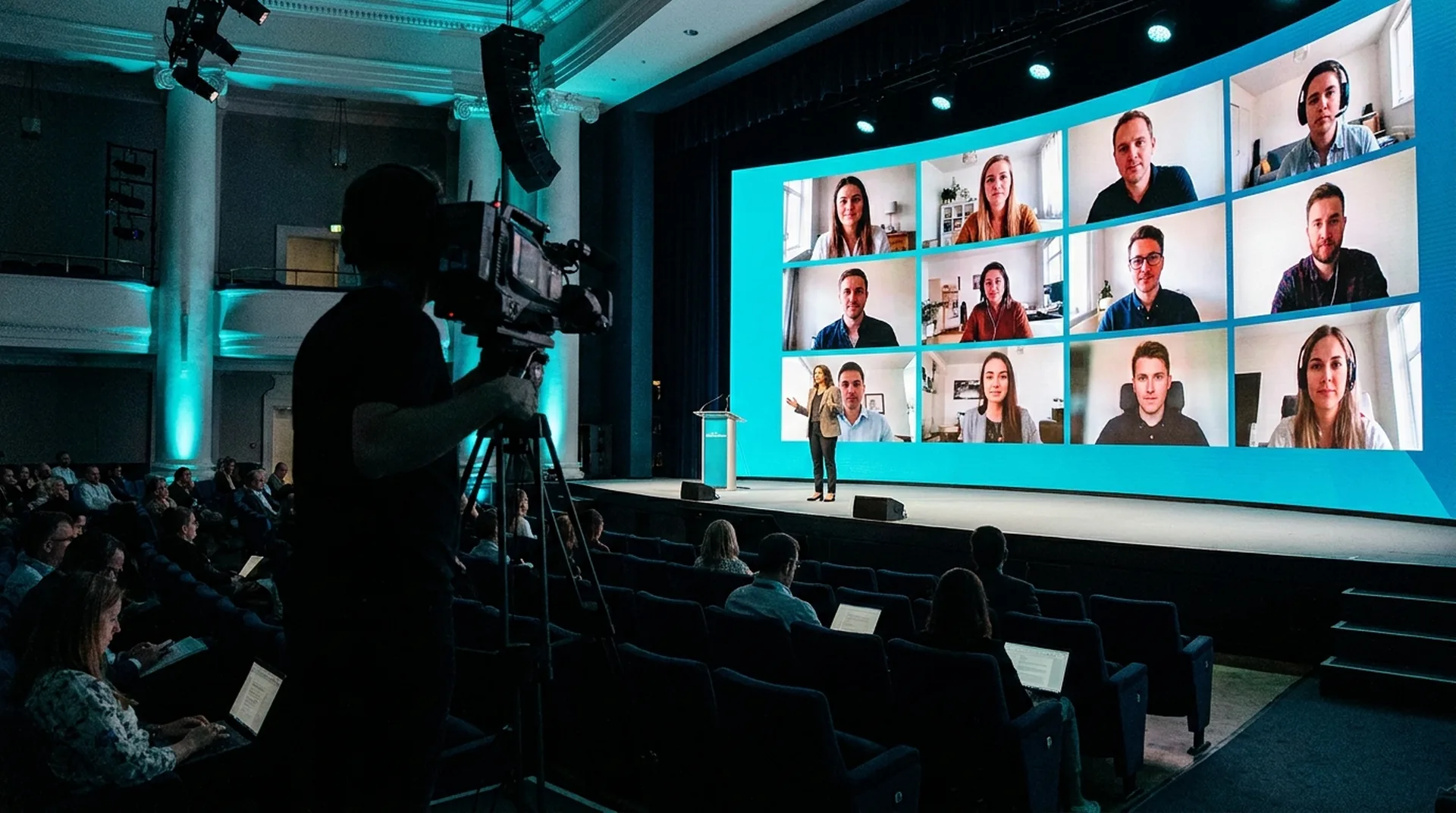
An in-person audience combined with online participants who join the event and ask questions. The ultimate challenge: audio feedback loops, latency management, and coordinating two different production flows simultaneously. In the Rhine-Main region, we manage hybrid events ranging from Messe Frankfurt to the RheinMain CongressCenter in Wiesbaden.
Why Redundancy Isn’t a Luxury
The difference between a 2,000-euro offer and a 6,000-euro offer often isn’t in the picture, but in what you don’t see: What happens if the encoder crashes? If the connection goes down? If a camera fails?
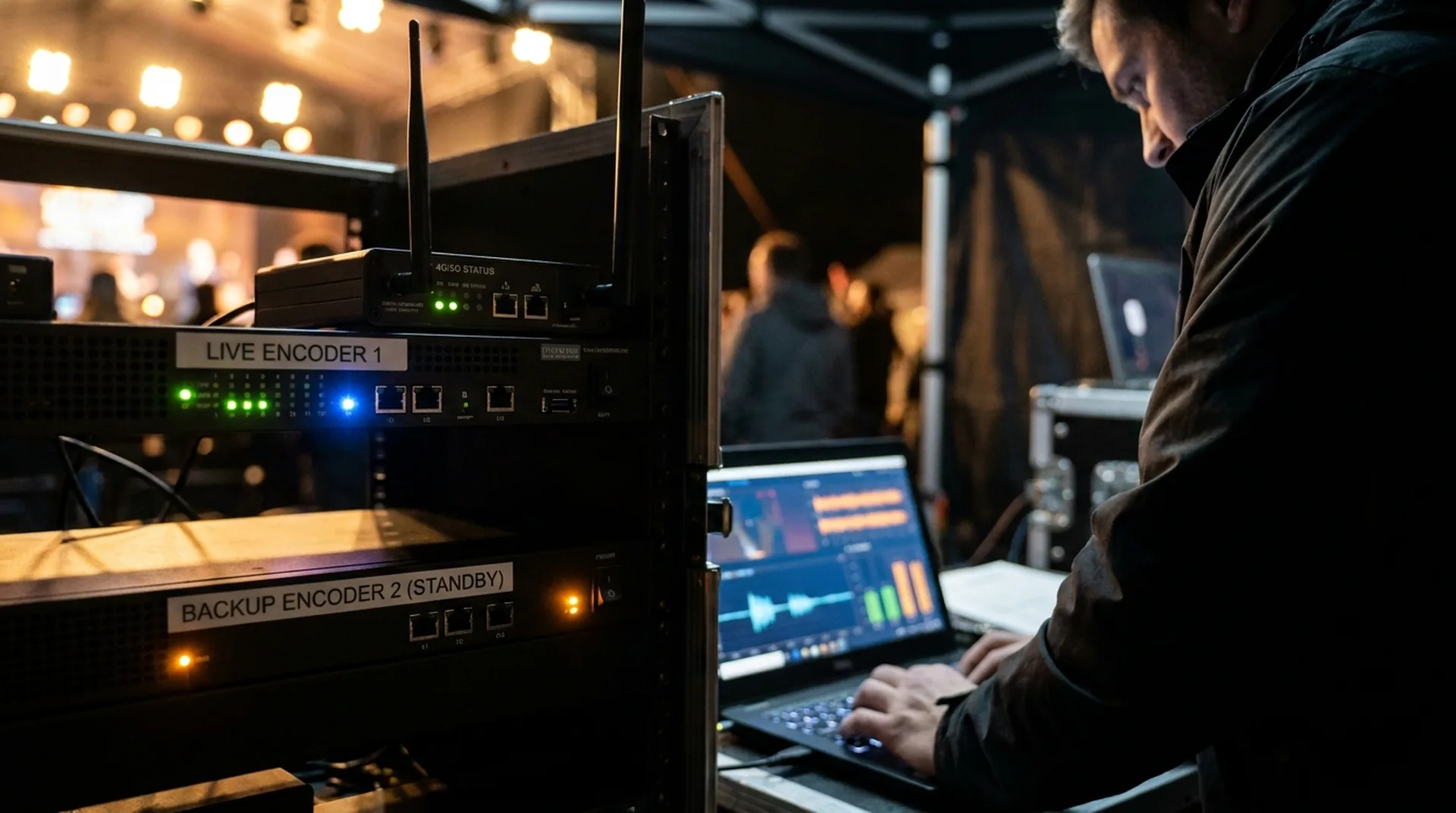
Professional standards for critical events: a second encoder on hot standby, a bundled internet connection from multiple networks, a backup camera in the setup, and a documented contingency plan. Ask this question with every quote: “What’s your Plan B if the main connection goes down?” The answer says more about the provider than any showreel.
GDPR, Co-determination, and Broadcasting Rights
Livestreams raise legal issues that are simply not addressed in low-cost solutions: Employees appearing on camera need consent; for internal streams, the works council often has a say; and music in the stream is a GEMA issue—even for the break playlist. For publicly accessible events, the audience’s personal rights must also be taken into account.
We’ve internalized these processes through productions for government agencies and corporations—from selecting a GDPR-compliant platform to camera work that respects the audience. This doesn’t incur any extra charges; rather, it’s simply part of sound production planning.
After the stream comes the content: secondary use
The greatest hidden value of a livestream is the content that comes after it. A recorded conference can be turned into topic-based clips for LinkedIn, quote tiles featuring the speakers, and a highlight reel for the next round of invitations. If you plan for this from the start, a single day of events can provide content for months—significantly more cost-effective than separate filming sessions.
Our event video for the city of Wiesbaden shows what this kind of event coverage looks like; the promotional video for the ICPO Foundation is an example of institutional communication. To find out how much a standard event documentary without a live broadcast costs, check out our guide, “Event Film Costs 2026.”
Here’s How a Live Stream Production Works
- 2–4 weeks in advance — Briefing & Technical Plan: Format, platform, number of cameras, location check, including on-site internet speed test.
- 1–2 weeks in advance — Pre-production: graphics, video clips, production schedule, backup plan; dress rehearsal for critical events.
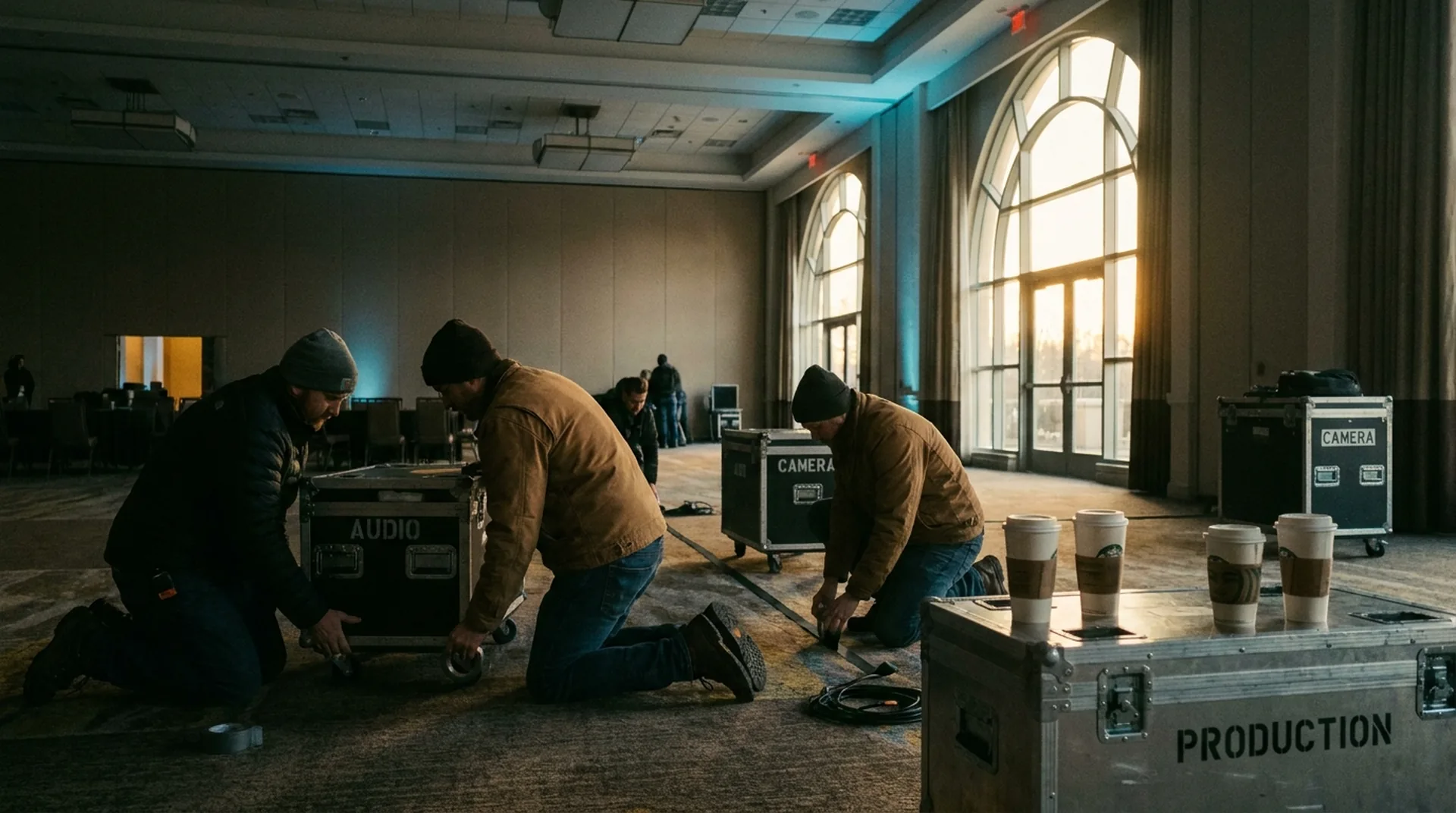
- Event Day — Setup & Broadcast: Setup 3–5 hours before the broadcast begins, signal test with all participants, then live broadcast with the production team.
- After the Event — Post-Event Use: Edited recording, chapter markers, optional highlight clips, and social media formats.
Hidden costs you should know about
- Platform Fees — GDPR-compliant business platforms charge additional fees based on the number of viewers
- Dedicated Internet connection — if the location does not offer sufficient upload speed
- GEMA & Music Licenses — Including for Intermission Music and Background Music
- Translation & Subtitles — Simultaneous streams for international participants use separate signal paths
- Extensions on the day of the event — if the program runs over, team hours continue to accrue; clarify the rates in advance
Frequently Asked Questions About Live Streaming Costs
How much does a simple livestream cost?
A lecture stream with one camera, clear audio, and broadcast on a platform costs between 1,500 and 2,500 euros. For lower prices, providers usually cut corners on audio or stability—the two factors that drive viewers away the fastest.
How many cameras do I need?
One is enough for a single speaker. For panel discussions, two to three perspectives are standard; for stage events with an audience, four to five. Rule of thumb: The longer the program, the more important it is to change perspectives.
What kind of Internet connection is required?
A stable upload speed of at least 10–20 Mbit/s, dedicated to the stream. Public Wi-Fi is not an option. Professionals check the location in advance and, if necessary, bring their own LTE/5G bonding connection.
YouTube, Vimeo, or our own platform?
Public events: YouTube offers wide reach and is free. Internal or confidential content: access-restricted, GDPR-compliant platforms hosted in the EU. We provide advice based on the format—the platform follows the content, not the other way around.
Can we record the stream and reuse it?
Yes, and you should definitely do that. The edited recording plus highlight clips turn that live moment into content that lasts—for the intranet, YouTube, and social media.
What is the difference between a livestream and a hybrid event?
With a livestream, the online audience watches. With a hybrid event, they participate: asking questions, voting, and joining in via video. This requires audio feedback loops and interactive technology—which explains the price difference.
What happens if the technology fails?
In professional productions: nothing the audience notices. Backup encoders, redundant lines, and spare hardware handle any outages. That’s exactly what the price difference from the budget option is for.
Conclusion: Stability is the real price
In 2026, live streaming will cost between 1,500 and 15,000 euros—and the difference rarely lies in the video quality, but rather in redundancy, staff experience, and preparation. A stream that freezes in front of 500 guests costs more in terms of reputation than any production could ever cost.
For a comprehensive overview of the prices for all video formats—from livestreams to TV commercials—see our pillar article, “Video Production Costs 2026.”
You can find details about our setup on the live streaming page, and related services under ” Event Videography ” and in our services overview.
Are you planning an event with a livestream?
Free initial consultation, including a technical assessment of your location. Price estimate within 24 hours.