
Video Production Costs in 2026: An Overview of All Prices
From social media clips to TV commercials: the comprehensive price chart for all video types—with links to detailed cost guides.
Reading time: 11 minutes | Updated: July 2026
Anyone commissioning a video production for the first time is often surprised when comparing quotes: Prices for what appears to be the same service range from 500 to 50,000 euros. The reason is rarely arbitrary—rather, it’s because “a video” isn’t a single product, but a catch-all term for a dozen very different types of productions, each with its own cost structure.
This page helps you get organized. We’ve been producing films for large corporations and small-to-medium-sized businesses for 15 years—over 1,000 productions, ranging from corporate image films and recruitment videos for Boehringer Ingelheim to TV commercials for Lidl. Here you’ll find an overview of all price ranges for 2026—and a link to our detailed cost guide for each video type.
The Short Answer: How Much Will Video Production Cost in 2026?
In 2026, a professional video production will cost between 800 euros for a single social media video and 50,000 euros for an elaborate TV commercial. Most corporate videos for small and medium-sized businesses—image videos, recruitment videos, and product videos—cost between 5,000 and 15,000 euros. The key factors determining the price are the number of shooting days, the size of the crew, the amount of post-production work, and the usage rights—not the length of the video.
The Master Price List: All Video Types 2026
All price ranges based on our production experience and current market data—each line links to the detailed cost guide for the respective video type:
| Video Type | Price Range 2026 | Detailed Guide |
|---|---|---|
| Social Media Video | €800–3,000 per video | Social Media Video Costs |
| Drone Footage | €450–5,000 | Drone Video Costs |
| Motion Design / Animation | Starting at €500 (€60–150/hour) | Motion Design Costs |
| Explanatory Video | €1,500–15,000 | Explanatory Video Costs |
| Product Video | €1,500–15,000 | Product Video Costs |
| 3D Animation | 1,500–15,000+ € | 3D Animation Costs |
| Live Streaming | €1,500–15,000 | Live Streaming Costs |
| Event Film | Starting at €3,500 | Event Film Costs |
| Recruiting Video | €3,000–20,000+ | Recruiting Video Guide |
| Promotional Video | €6,000–30,000 | Cost of a Promotional Video |
| Promotional Video | Starting at €8,000 | Promotional Video Costs |
| YouTube Ads Video | €3,000–15,000 | YouTube Ads Costs |
| TV commercial | €8,000–50,000 | TV Commercial Costs |
More Cost Guides: Promotional Video Costs · Advertising Video Costs · Drone Footage Costs
How much will your project cost, specifically?
Tell us briefly what you have in mind—during the free initial consultation, you’ll receive an honest assessment with no obligation.
All prices are net; these are approximate figures for professional productions in Germany in 2026.
Two notes on reading the table: First, the lower ends of each range describe the most basic professional production—an interview setup, a location, and standard post-production. If you receive quotes significantly below these ranges, you’ll typically get cookie-cutter work or amateur-level results. Second, these categories overlap in practice: a recruitment video often includes drone footage, a promotional video features motion design elements, and a product video incorporates 3D sequences. Costs are calculated as an integrated package rather than separately—one reason why a production from a single provider is usually more cost-effective than four separate service providers.
A Brief Overview of Video Types: Which One Fits Your Goal?
Before you compare prices, it’s worth considering the question behind it: Which video actually solves your problem? Here’s a quick overview of the main types—details for each can be found in the linked guide.
Brand & Trust: Image Film and Brand Film
The corporate image film is the company’s calling card—6,000 to 30,000 euros, depending on the number of shooting days and the scope of the project. Conceived as a documentary-style brand film, it doesn’t showcase a glossy facade, but rather real people and real work: this is the format with the longest lifespan and the strongest trust-building effect. As with the corporate image video for Heidler, such a film often remains relevant for three to five years.
Employee Recruitment: Recruitment and Employer Branding Videos
3,000 to 20,000+ euros; effective productions start at around 8,000 euros. The key cost factor isn’t the technology, but rather the time the team needs to get employees to speak authentically on camera—and that’s exactly where low-budget productions fall short. If you’re targeting multiple audiences (trainees, skilled workers, executives), a series is more cost-effective than individual films.
Sales & Product: Product, Explanatory, and Promotional Videos
Product videos start at 1,500 euros for studio shoots and go up to 15,000 euros for 3D renderings. Explanatory videos (1,500–15,000 euros) break down complex services into two minutes of clarity—whether animated or live-action. Promotional videos and TV commercials (starting at 8,000 euros) are the top tier: these include actors, set design, and a media budget.
Reach & Continuity: Social Media, Events, Streaming
Social media videos cost between 800 and 3,000 euros each—a “Content Day” starting at 2,500 euros is significantly more efficient, as it produces several clips at once, as was the case with the social media content for Miyen. Event videos start at 3,500 euros, professional live streaming at 4,500 euros, and drone footage as a supplement at 1,200 euros.
What Each Video Price Is Made Up Of
Whether it’s a promotional video or a social media clip—every reputable quote consists of the same four components. If you know what they are, you can compare quotes instead of just looking at the total prices side by side.
Stock image, AI-generated
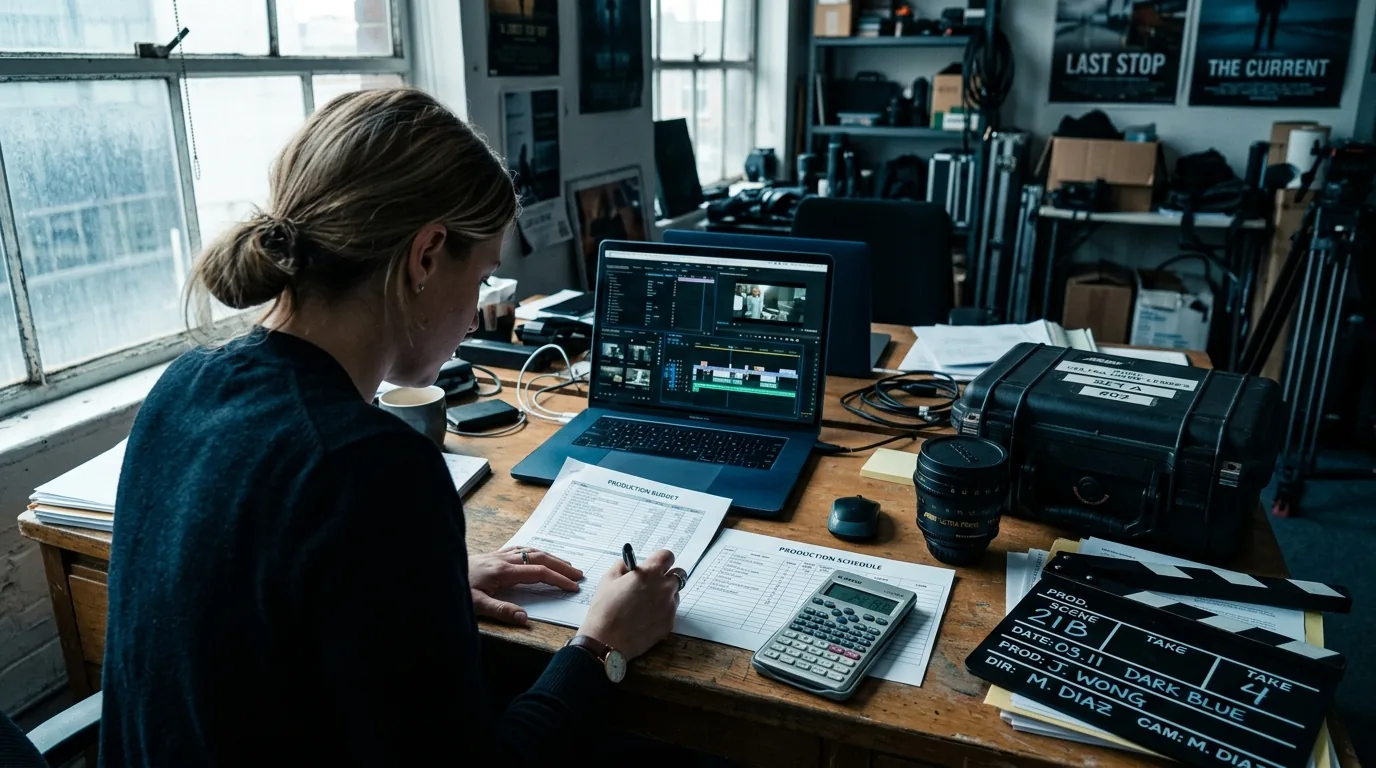
1. Concept Development and Pre-Production (10–20%)
Briefing, concept, script, or interview guide; location scouting; production schedule. This phase determines the film’s impact—and is the first thing to be cut in low-cost productions. You can see the result in the film itself.
2. Production: Shooting Days and Crew (40–50%)
A day of shooting is the most expensive unit in any production. A two-person crew with camera, lighting, and sound costs 1,500 to 2,500 euros per day; larger crews, including a director, second camera operator, and makeup artist, cost correspondingly more. The most important budget question is therefore not “How long will the film be?” but “How many shooting days will it require?”
3. Post-production (25–35%)
Editing, color correction, sound mixing, music, graphics, and subtitles. As a rule of thumb, each day of filming requires two to four days of post-production. Complex animations and motion graphics are billed separately.
4. Rights and Licenses (5–15%)
Music licenses, voice-over fees, and, if applicable, buyouts for professional actors. Anyone who plans to use the film later as a TV or movie theater commercial must pay for extended usage rights—this should be included in the briefing upfront, not added to the invoice afterward.
What do you get for your budget?
Stock image, AI-generated
Up to 5,000 euros: a focused entry point
One day of filming, a small team, a clear focus: a social media package, a concise statement video, an event film, or a simple explainer video. When well-planned, this isn’t a “cheap video,” but a precise one—the art lies in condensing the requirements into a single day of filming. A “Content Day,” during which several short videos are produced in a single day, is the most efficient approach in this category.
5,000 to 15,000 euros: the standard for small and medium-sized businesses
This is where most corporate films are produced: one to three days of shooting, an experienced team, well-structured storytelling, and professional post-production. Whether it’s a corporate image film, a recruitment video featuring real employee testimonials, or a high-quality product video, our entry-level “Brand Portrait” package (starting at 12,000 euros) falls into this category: a documentary-style brand film plus edited versions for the web and social media.
Starting at 15,000 euros: Campaigns and TV series
Multiple days of filming, multiple locations, actors if needed, and extensive post-production: promotional films, TV commercials, large-scale image films, or video series that showcase an employer brand over the course of months. This is where strategic thinking pays off: Instead of a single flagship film, we usually work with clients to plan an annual package consisting of a main film, employee testimonials, and series content—the brand story (starting at 22,000 euros).
Three Real-World Pricing Examples
Abstract time frames become more concrete when considered in the context of typical projects, such as those we receive requests for every week:
Example 1 — Mechanical engineering company, 80 employees, seeking skilled workers: Recruitment video featuring three testimonials from actual employees, one day of filming at the plant, main video 2:30 min. plus three vertical clips for social media. Budget: approx. 9,500 euros.
Example 2 — SaaS provider needs marketing materials: A 90-second animated explainer video with custom illustrations, a professional voice-over artist, and two language versions, plus a short version for LinkedIn Ads. Budget: approximately 7,000 euros.
Example 3 — A medium-sized company looking to rebrand: A documentary-style brand film shot over two days at two locations, featuring interviews with management and the team, drone footage, a 3-minute main film, and five different edits. Budget: approximately 18,000 euros.
All three examples follow the same pattern: The price is determined by the number of shooting days, the scope of post-production, and the number of release formats—not by the film’s length alone. And in all three cases, one shooting day yields enough footage for significantly more than one film.
The 7 Biggest Cost Drivers
- Shooting days — the biggest cost driver: Each additional day costs 1,500 to 3,500 euros, including follow-up costs in post-production.
- Team size — ranging from a two-person documentary team to a ten-person crew with a director, lighting department, and makeup team.
- Locations — every additional location means setting up, travel, and lost time; rental locations and studios cost extra.
- Actors and Buyout — real employees cost nothing; professionals cost 500 to 1,500 euros per day plus usage rights.
- Animation and Graphics — Motion graphics, 3D elements, and animated infographics are billed based on the amount of work involved.
- Aspect ratio options — 16:9, 9:16, and 1:1 are separate edits; they cannot be selected with the push of a button.
- Revision rounds — two rounds are standard; clear approval processes on your end save you money.
Why “Cheap” Often Ends Up Costing Twice as Much
The most expensive video is the one that no one takes seriously. A video isn’t just a decorative element—it’s a foundation of trust: Within the first few seconds, it determines whether applicants, customers, or partners will believe you. Generic stock footage, staged scenes, and a narrator who sounds like every other voice out there create the exact opposite of trust—a sense of indifference.
Our approach, therefore, is the documentary-style brand film: real people, real work situations, real statements—cinematically condensed rather than staged. This costs no more to produce than a conventional staged production, but it has a measurably different impact: Films that generate brand resonance are used both internally and externally for years, rather than disappearing after the first campaign. That’s why you should always calculate video costs based on their useful life: A 12,000-euro film that lasts three years is more cost-effective than a 4,000-euro film that’s replaced after six months.
A second point that comparisons of total costs overlook: the follow-up costs of poor bids. If a low-cost quote omits subtitles, format variations, music licensing, or a second round of revisions, these items will be added later as supplements—and what seemed like a bargain ends up being the most expensive option. Therefore, never compare prices; instead, compare service specifications: What exactly is included in terms of shooting days, post-production, rights, and delivery formats?
Agency, freelancer, or in-house?
A single videographer costs between 800 and 1,500 euros per day of filming and is often the most cost-effective choice for simple, clearly defined tasks. A film production company makes sense when the concept, storytelling, and post-production are all to be handled by a single provider—or if the project would fail should a single person be unable to work. In-house production using your own equipment is only worthwhile if there is a consistent need for several videos per month; the hidden costs (staff, equipment depreciation, training) are regularly underestimated.
In practice, this approach has proven effective: produce strategic videos—such as corporate image videos, recruiting campaigns, and promotional videos—externally with a partner who understands the brand; create quick, up-to-the-minute formats internally, ideally using footage and templates from the professional productions.
7 Legitimate Ways to Cut Costs
- Block Production: Shooting multiple videos in a single day—the most effective way to save money, often resulting in savings of 30–40% per video.
- Use Your Own Locations: Your production site, your office, and your people are more authentic than any rented studio—and they’re free.
- Employees instead of actors: saves on fees and buyouts and has a greater impact in recruitment and promotional videos.
- Clear approval processes: Having one person with decision-making authority reduces the need for back-and-forth revisions—every additional round adds to the cost.
- Plan for different aspect ratios from the start: It’s cost-effective to account for portrait orientations during filming, but doing so later is expensive.
- Stock music instead of original compositions: More than enough for most corporate videos.
- Think long-term: A raw footage archive and series templates make each subsequent production more cost-effective.
What you shouldn’t skimp on: the concept and the sound. A poorly conceived film completely misses the mark, and poor sound quality renders even beautiful images useless.
Video Production in the Rhine-Main Region: The Location Advantage
Travel expenses and local knowledge are often underestimated cost factors. For companies located between Frankfurt, Wiesbaden, and Mainz, producing with us is a breeze: no per diem allowances for lodging, short travel times, and well-established contacts with venues and government agencies—such as for filming permits or drone flights in restricted airspace. For productions lasting several days, this alone can quickly add up to four-figure amounts.
Added to this is a “soft” factor that pays off in a big way: proximity. When the production site is just 20 minutes away, on-site preliminary meetings, spontaneous reshoots, and in-person approvals are a given—not an expense, but simply part of how we work. From our location on Wielandstraße in Wiesbaden, we’ve been serving companies throughout the Rhine-Main region—from Darmstadt to the Rheingau—for 15 years.
Here’s How a Video Production Works
- Weeks 1–2 — Briefing & Concept: Objective, Target Audience, Core Message, Budget; followed by a concept and proposal with transparent line items.
- Weeks 3–4 — Pre-production: shooting schedule, locations, preparation of the main characters, and filming permits, if necessary.
- Week 5 — Filming: One to three days of shooting; using a documentary-style approach with a deliberately small crew, which helps build trust in front of the camera.
- Weeks 6–8 — Post-production: Editing, feedback sessions, color correction, sound, music, subtitles, format variations, delivery.
Realistic total lead time: six to eight weeks from the initial consultation to the finished film. Express productions are possible but incur an additional charge—planning is the most cost-effective strategy of all.
Hidden costs you should know about
- Buyout / Usage Rights — Additional licenses are required for advertising use when professional performers or certain music are involved
- Music Licenses — GEMA-free library music is usually included; exclusive compositions cost extra
- Subtitles & Accessibility — Mandatory for Many Companies Since the BFSG; See Our Guide to Accessible Videos for Details
- Format Variations — Each Platform Version Involves Editing
- Travel and lodging expenses — a separate line item for productions outside the region
- Providing raw material — usually for a fee, but valuable for long-term content strategies
Frequently Asked Questions About Video Production Costs
How much does a professional video production cost?
Prices range from 800 euros for a single social media video to 50,000 euros for a TV commercial. Most corporate videos cost between 5,000 and 15,000 euros—depending on the number of shooting days, the crew, and post-production.
How much does one minute of video cost?
Per-minute rates are misleading: A day of shooting costs the same, whether it results in 60 or 180 seconds of film. As a rough guide, market overviews cite 1,000 to 10,000 euros per finished minute of film—it’s better to base your calculations on shooting days and the amount of work involved.
How much does a camera crew cost per day?
A professional two-person crew equipped with camera, lighting, and sound equipment costs between 1,500 and 2,500 euros per day of filming. Larger crews, including a director, a second camera operator, and a makeup artist, cost 3,500 euros or more.
Why are the price differences so large?
Because “video” isn’t a product: There’s a world of difference between a smartphone clip edited using a template and a promotional film produced with a crew, actors, and color grading. Offers can only be compared once the number of shooting days, team size, scope of post-production, and usage rights are specified individually.
Which video is a good place to start?
It depends on the bottleneck: If there’s a shortage of applicants, a recruitment video is usually the quickest solution. If the sales team needs content, product or explanatory videos are a good choice. To build brand awareness, we recommend a brand profile—a main video plus edited versions that can be used across all channels.
How do I calculate an annual video budget?
The series model has proven effective: a main film as the foundation (5,000–15,000 euros), supplemented by quarterly content formats such as employee spotlights or behind-the-scenes footage. This creates continuous visibility rather than a one-time highlight—with predictable costs.
Are the prices negotiable?
A more sensible approach than haggling over discounts is to adjust the scope of the project: fewer shooting days, using existing locations, hiring staff instead of actors, and block-shooting multiple videos in a single day. This lowers the cost without compromising the quality of each scene.
How much does video production cost in Frankfurt or Wiesbaden?
The price ranges are in line with the national average—the advantage of regional production lies in the elimination of travel and lodging costs, as well as shorter coordination processes. For companies in the Rhine-Main region, this saves anywhere from several hundred to several thousand euros, depending on the project.
How much will your project cost, specifically?
Free Initial Consultation — Within 48 hours, you’ll receive an honest assessment with transparent line items instead of a flat fee.