
3D Animation Costs in 2026: How Much Do 3D Visualizations and Product Animations Cost?
From 1,500 euros for a simple product animation to a photorealistic high-end film: realistic prices and the biggest cost-saving opportunity that hardly anyone takes advantage of.
Reading time: 10 minutes | Updated: July 2026
3D animation shows what a camera cannot film: the inner workings of a machine, how a drug works, or a building that hasn’t been built yet. That’s exactly why industrial companies, architects, and medical technology manufacturers regularly ask us: “How much does this cost?” And more than with any other type of video, the answer depends on what you want to show—and what data you already have.
We’ve been producing films for the industrial and technology sectors for over 15 years—from a trade show film for robot manufacturer FANUC to motion graphics productions for Bosch. Here’s our transparent 3D pricing overview for 2026.
The short answer: This is how much 3D animation will cost in 2026
In 2026, a professional 3D animation will cost between 1,500 and 15,000+ euros. Simple product animations lasting 10–30 seconds range from 1,500 to 3,000 euros; more detailed animations lasting 30–60 seconds range from 3,000 to 10,000 euros; and photorealistic, high-end productions cost more than that. As a rule of thumb: 40 to 150 euros per second of animation, or 6,000 to 12,000 euros per minute, in the mid-range quality segment. Individual 3D renderings (still images) cost 200 to 1,500 euros.
3D Animation Costs by Use Case
Price ranges vary significantly depending on the application:
| Use Case | Budget | Typical Scope |
|---|---|---|
| Product Animation (Simple) | €1,500–3,000 | 10–30 sec., one product, studio look, camera pan |
| Technical/Functional Animation | €3,000–10,000 | 30–60 sec., exploded views, cutaway models, functional sequences based on CAD data |
| Architectural Visualization | Starting at €2,000/min | Building fly-throughs, interior tours, lighting effects |
| Medical Animation | Starting at €4,000/min | Mechanisms of action, surgical procedures — scientific review included |
| 3D Inserts in Live-Action Films | €2,000–8,000 | Machine internals, data flows, or product details as sequences in a promotional video |
| High-end / photorealistic | €10,000–30,000+ | Over 60 seconds, simulations (liquids, particles), campaign-quality |
More Cost Guides: Promotional Video Costs · Advertising Video Costs · Drone Footage Costs
How much will your project cost, specifically?
Tell us briefly what you have in mind—during the free initial consultation, you’ll receive an honest assessment with no obligation.
All prices are net and are approximate.
Why 3D Is More Expensive Than 2D: The Production Pipeline
A 3D animation goes through more stages than any other type of video: modeling (the object is created digitally), texturing and shading (surfaces, materials, realism), rigging and animation (movement), lighting and camera work (staging), and finally rendering —the calculation of each individual frame, which can take several minutes per frame for photorealistic quality. At 25 frames per second, one minute of animation amounts to 1,500 rendered frames. This pipeline explains both the cost and the most important rule: changes made early on are inexpensive; changes made after rendering are expensive.
The biggest cost driver: Your CAD data
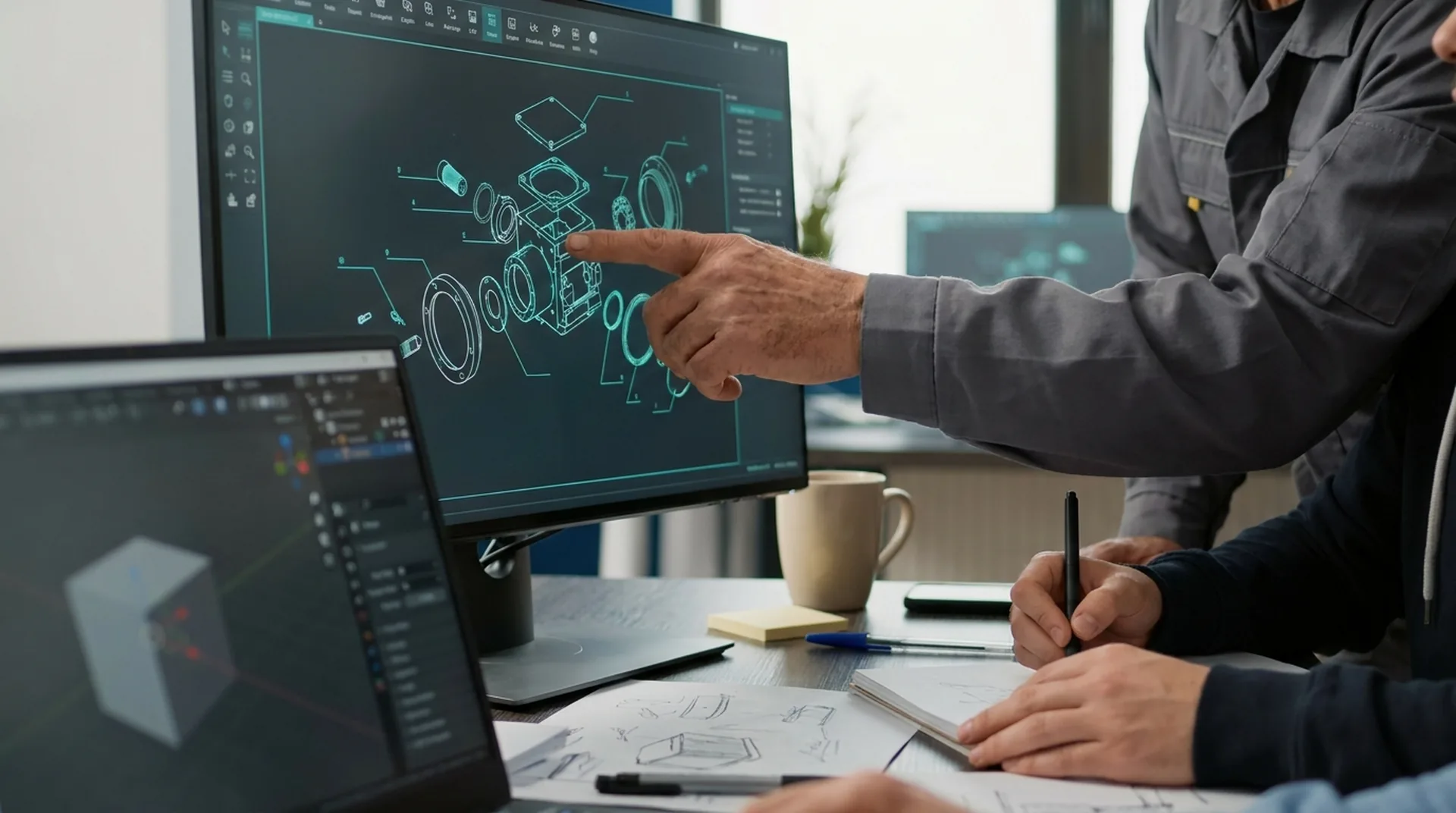
This is where industrial companies waste the most money—in both directions. If your product exists as a CAD file (STEP, SolidWorks, Inventor), it doesn’t need to be modeled from scratch: The data is converted, simplified, and prepared for animation. Depending on the complexity, this saves 30 to 60 percent of the modeling costs.
Stock image, AI-generated
Pre-inquiry checklist: What CAD formats are available? Are the models complete (including internal components, if they are to be shown)? Are there material specifications and CI color values? If you can answer these three questions during the initial consultation, you’ll receive a much more precise—and usually more affordable—quote.
The 5 Cost Factors in 3D Production
1. Level of Detail and Photorealism
A stylized tech look is significantly less expensive than photorealism. The question is a strategic one: Should the animation look like a photo (product advertising) or be clearly recognizable as a visualization (explanation of how something works)? Both approaches are valid—the price difference ranges from two to four times.
2. Length and Camera Movements
Every second needs to be animated and rendered—the rule of thumb is 40 to 150 euros per second. Well-planned camera movements can convey a message in 20 seconds, while poorly conceived ones take 60.
3. Simulations and Effects
Liquids, smoke, particles, materials: Physics simulations are the pinnacle of the field and, as such, are extremely complex. A single water droplet that realistically rolls down a product can cost more than the entire rest of the animation.
4. Rendering and Iterations
Render time is processing time is money. That’s why professionals work with preview-quality images for revisions and only render the final version after approval. Your contribution to budget discipline: Provide feedback consistently during the preview phase—not on the finished image.
5. Sound and Integration
Sound design is what makes 3D believable—the deep click of a mechanism, the whir of a drive. Then there’s integration: Should the animation stand alone, or be embedded in a promotional video, a trade show presentation, or an explanatory video?
3D Meets Live-Action: The Hybrid Industrial Film
Stock image, AI-generated
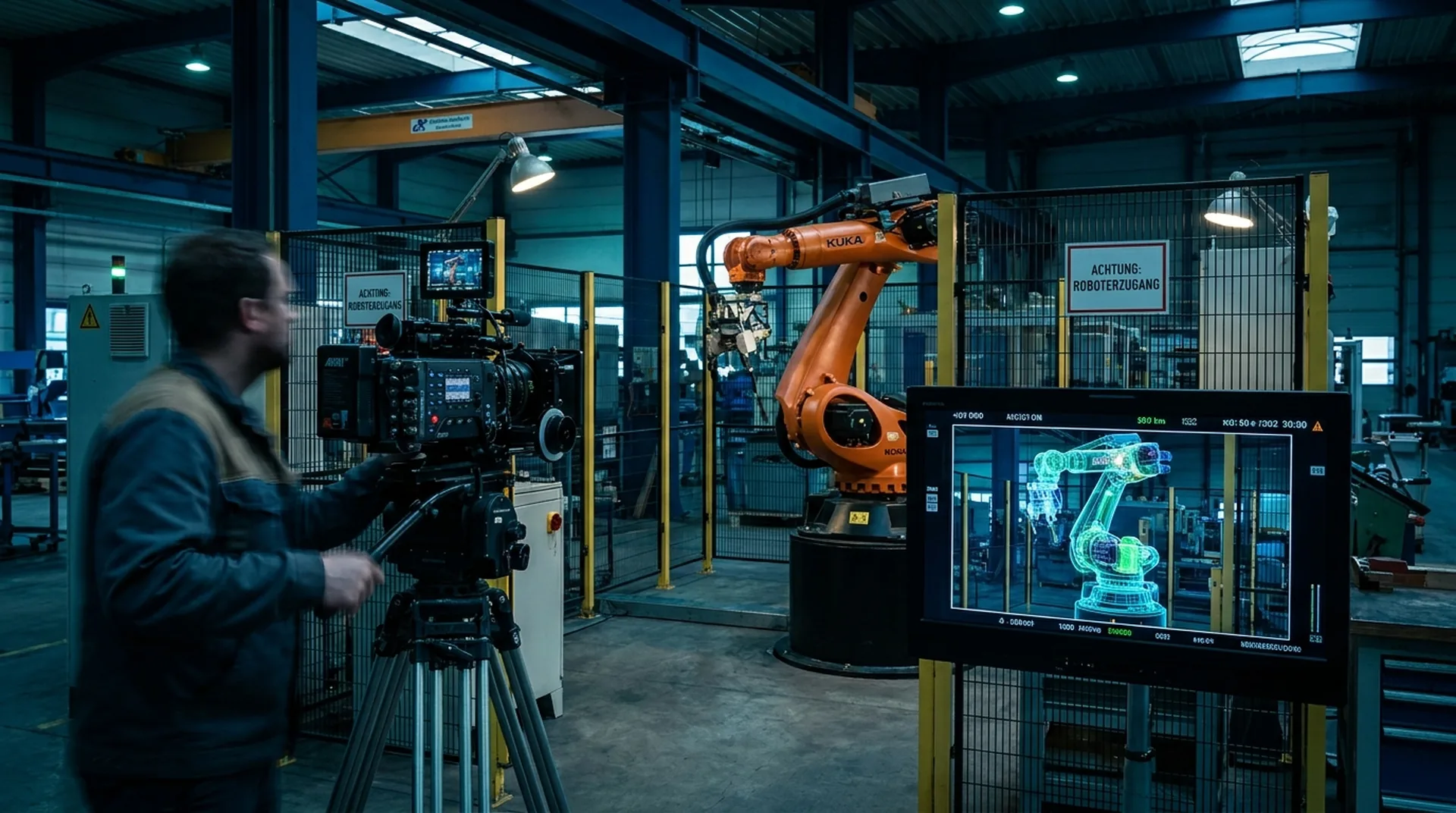
In 2026, the most powerful effect will rarely come from pure 3D films, but rather from a combination of documentary-style footage of people and machines—and, precisely in those places where the eye cannot reach, a seamless transition into the 3D world. The viewer sees the actual production process, dives into the interior of the facility, and returns to the factory floor. This combines authenticity with explanatory power—and makes the most of the budget, because one day of filming plus targeted 3D sequences is often more cost-effective than 90 seconds of full CGI.
As a film production company with our own animation department, we handle both types of projects under one roof—from corporate videos with 3D inserts to technical explainer videos.
Here’s How a 3D Production Works
- Week 1 — Briefing & Data Review: Objective, distribution channel, CAD data review, style references.
- Week 2 — Concept & Style Frames: Storyboard, Look Development, Approval of the Visual Style.
- Weeks 3–4 — Modeling & Shading: Preparing CAD data or creating new models, materials, lighting.
- Weeks 4–6 — Animation: Movement and camera movements in preview quality — Your most important feedback phase.
- Weeks 6–8 — Rendering & Compositing: Final rendering, color correction, sound design, delivery in all formats.
Hidden costs you should know about
- CAD Data Preparation — Incomplete or Overly Complex Data Increases Preparation Time
- Changes after rendering — any correction to the finished image triggers new rendering runs
- Product variants — each color or model variant requires its own render run
- Resolutions higher than Full HD —4K for trade show LED walls quadruples rendering time
- Source Files & Assets — The 3D models themselves usually require a separate license
Frequently Asked Questions About 3D Animation Costs
How much does one minute of 3D animation cost?
In the mid-range quality segment, prices range from 6,000 to 12,000 euros per minute. Architectural visualizations start at 2,000 euros per minute, medical animations at 4,000 euros—and photorealistic product videos are priced higher than that.
How much does a single 3D rendering cost?
A still image costs between 200 and 1,500 euros, depending on the complexity of the modeling. Good to know: Once the model is built, additional perspectives and variations are relatively inexpensive.
Why is 3D animation more expensive than 2D animation?
Because a complete digital world has to be built before the animation can begin: models, materials, lighting. On top of that, there’s the rendering time for each individual frame. In return, 3D can achieve what 2D cannot—true spatial depth and photorealism.
We have CAD data—what are the benefits?
30 to 60 percent of modeling costs. The data must be converted and optimized, but the most expensive step—digitally recreating the object—is eliminated.
How long does a 3D production take?
Six to eight weeks for a typical product animation. High-end projects involving simulations take longer—mainly due to rendering times and approval rounds.
Is 3D Worth It for Trade Shows?
Very — hardly any other format attracts as much attention at a trade show booth as a high-quality product animation playing on a loop. Important: Clarify the resolution and format of the LED wall in advance, as this affects rendering costs.
Conclusion: 3D is worth it when it reveals the invisible
In 2026, 3D animation will cost between 1,500 and 15,000+ euros—and it’s worth the price precisely when it shows what a camera can’t. The two best ways to save money: use existing CAD data and provide thorough feedback before the final rendering.
Related Topics: Our guide to explainer video costs for 2D alternatives and an overview of all services.
This guide is part of our comprehensive price overview—you can find all video types and price ranges at a glance in our pillar article, “Video Production Costs 2026: A Complete Price Overview.”
Does your product deserve to take on a third dimension?
Free initial consultation, including a CAD data check—we’ll give you a specific quote for your animation.