
AI Video vs. Real Film Production: The Honest Cost Comparison for 2026
What AI videos really cost, where they’re perfectly adequate, where they harm brands — and why the total bill looks different from the quoted price.
Reading time: 11 minutes | Updated: July 2026
Hardly any other budget issue will be debated as passionately in 2026 as this one: Is an AI-generated video enough—or is a real film production still necessary? The answers you get on the market suspiciously often depend on who’s giving them: AI video agencies promise 90 percent savings, while traditional producers issue sweeping warnings about the demise of the brand world. Both are sales pitches.
We’re taking a different approach here: an honest comparison. We’ve been producing films for 15 years—and we use AI tools ourselves wherever they make our productions better and more efficient; we’ve described exactly how in our article “AI in Video Production.” That’s exactly why we can break down both sides of the equation: what AI videos cost, what they deliver, where they make sense—and where the supposed savings end up costing more.
The Short Answer: The Cost of AI Video and Film Production in 2026
In 2026, an AI video will cost between 20 euros (tool subscription, self-production) and 12,000 euros (professionally produced by an agency) — the market range for agency-produced AI videos is 1,800 to 12,000 euros. Full-scale film production starts at 800 to 3,000 euros per social media video; explainer videos cost 1,500 to 15,000 euros; image films 6,000 to 30,000 euros, and advertising films starting at 8,000 euros. However, a simple price comparison can be misleading: iterations, rights issues, labeling requirements, and the short shelf life of generated visuals must all be factored into any serious overall calculation.
The Price Comparison: Both Worlds Side by Side
How much the typical formats will cost in 2026 — produced and filmed:
| Format | Budget | Typical Use |
|---|---|---|
| AI video, created by the user (tool subscription) | €20–500/month | In-house quick formats, tests, previz — quality varies widely |
| AI Video About the Agency | €1,800–12,000 | Concept, Prompting, Generation, Voice, Editing, Format Variations |
| Social media video, actually filmed | €800–3,000 | Real people and locations, reusable raw footage |
| Explanatory Video (Animation, actually produced) | €1,500–15,000 | Custom illustrations and storytelling instead of a template-like look |
| Promotional film, shot in a documentary style | €6,000–30,000 | Real employees, real spaces — building trust, long-term use |
| Promotional Video / Campaign Spot | Starting at €8,000 | Production, acting, campaign aesthetic, full usage rights |
All prices are net and are approximate. AI market prices: industry-standard agency quotes for 2026.
What You Get for Your Money: The Two Offers Inside
Today, a reputable mid-range AI video service offers more than just “enter a prompt”: concept development and storyboarding, a script with hook variations, prompt engineering across multiple model generations, voice-over or voice cloning, sound design, editing, and delivery in 16:9, 9:16, and 1:1. This explains why professional AI videos cost four-figure sums—the human contribution to concept development and curation remains the largest expense; only the video production step is automated. The timelines are actually shorter: two to fifteen business days instead of six to twelve weeks.
A production package includes the same conceptual services—plus what can’t be generated: a day of filming at your company, real employees and executives in front of the camera, properly handled consent forms and usage rights, and an archive of raw footage that will feed into other formats for years to come. The comparison “same price, but AI is faster” therefore falls short: these are two different products. One delivers moving images to convey your message; the other documents your reality—and only the latter can serve as evidence.
Staying Fair: When AI-Generated Video Is More Than Enough
Anyone who claims that AI-generated video is useless hasn’t looked at the tools in a long time. There are areas of application where generated videos are the economically sensible choice:
- Internal Quick Formats: Training snippets, process updates, HR announcements — content with a short lifespan and an internal audience, where speed matters more than brand impact.
- Prototyping and Pre-Visualization: Seeing a concept as an animated storyboard before the actual production is commissioned—this helps avoid bad decisions and is one of the best use cases for AI.
- Variation Testing: Test twenty different hook variations for a performance campaign before producing the winning idea to a high standard.
- Illustrative interludes: Abstract concepts, future scenarios, or situations that cannot be filmed, which are incorporated into larger productions as clearly recognizable illustrative elements.
The common pattern: AI-generated video works well in situations where the content doesn’t have to embody the brand —internally, in testing, or in the pre-production phase. Things get tricky precisely when the video is supposed to speak on behalf of the company.
The Confidence Vote: What the Research Shows
This is where the comparison gets serious—and measurable. The ARD Media Study on the Perception of AI in Programming and Advertising (2025) paints a clear picture: 70 percent of respondents have already noticed AI-generated advertising, and although 63 percent find it difficult to distinguish it from traditional advertising in individual cases, a vague sense of mistrust remains: Only 26 percent perceive brands using AI-generated advertising as trustworthy, and only 24 percent as authentic. At the same time, according to recent surveys, 77 to 86 percent of Germans expect AI-generated content to be clearly labeled—an expectation that the EU AI Act now legally underpins for certain types of synthetic content.
What this means for your budget decision: An AI-generated video can appear more modern—45 percent of respondents agree. But for formats whose sole purpose is to build trust (image films, recruitment videos, customer testimonials, company profiles), opting for the cheaper production method comes with a measurable risk to credibility. Trust is precisely the currency in which these videos are paid for.
The second level of the findings is interesting: 60 percent say that transparency regarding the use of AI would increase their trust. So, anyone using AI-generated videos is best off clearly labeling them—which, in turn, eliminates the “looks like it was actually filmed” effect. This dilemma cannot be eliminated through optimization; you should be aware of it before making a decision.
Added to this is a trend that exists independently of AI but is accelerated by it: Audiences are generally turning away from perfectly staged content and preferring unscripted, real-life depictions—a shift described in the industry as a move away from classic glossy content toward real-user content. Synthetic perfection thus clashes with an audience that is seeking exactly the opposite: recognizably real people in recognizably real situations. This shift plays right into the hands of documentary-style production—not out of nostalgia, but because it delivers what has been proven to build trust.
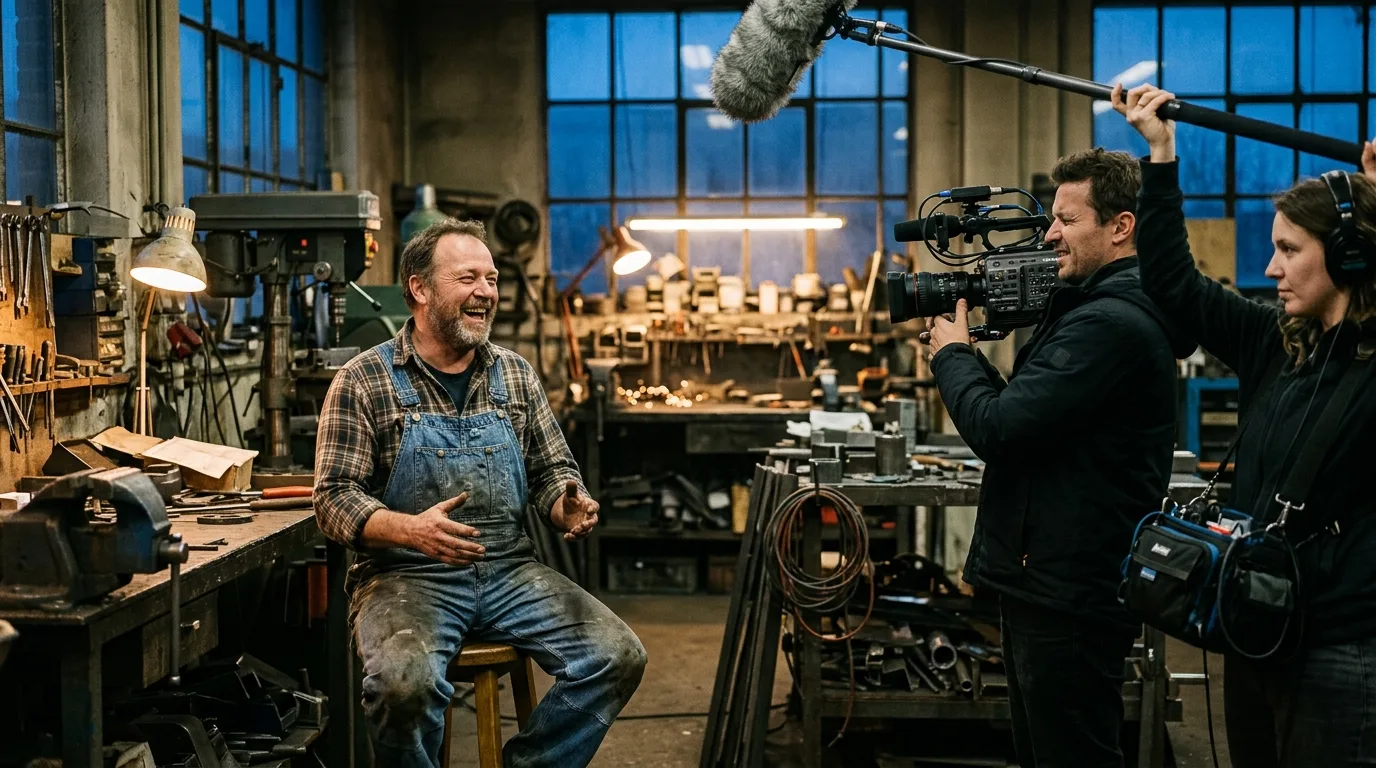
Interview scene from a real film production (stock image, AI-generated)
Total Cost: Why the List Price Isn’t the Whole Story
1. Iteration Loops
Generative models produce impressive results—but they don’t reliably deliver what you want. The specific pose, a consistent character across multiple scenes, a product with accurate details: To achieve these, many variations are generated, reviewed, and discarded. With agency services, this work time is factored into the price (which is why good AI videos cost 5,000 euros and not 50); with in-house production, your team pays for it with their working hours.
2. Rights and Labeling
In film production, copyright and usage rights are clearly defined in contracts. With generated content, however, questions remain: the origin of training data, the protectability of the results, platform terms of use, and transparency requirements under the EU AI Act for synthetic content. For an internal training video, this is manageable—but for a campaign involving media spending, legal clarification is a real cost factor.
3. Half-life of the look
Generated videos bear the mark of their model generation. What impresses us today will, in eighteen months, look unmistakably like “AI from back then”—just as everyone today recognizes the visual styles of 2023. A documentary-style film featuring real people, on the other hand, ages with dignity: it becomes a historical record, not a technological artifact. For content with a lifespan of three to five years, this significantly changes the equation.
4. No Raw Material Archive
A day of filming produces hours of footage that continues to be used for years: social media clips, recruitment videos, website loops, trade show content. A generated video produces—itself. For the next version, it’s regenerated, with new iterations and no guarantee that characters and locations will remain consistent. The reusability of real footage is the most overlooked factor in this comparison.
5. Interchangeability
Everyone uses the same templates—and the results visibly converge into a uniform look. If your video was created using the same tool as your competitor’s, the cost advantage also becomes a disadvantage in terms of differentiation. Your business, your people, and your spaces, on the other hand, are one-of-a-kind.
Sample Calculation: A Recruitment Video Over Three Years
Let’s look at a typical example to illustrate the total cost analysis: A medium-sized company needs video content for recruitment, with a three-year usage period.
Option A — AI Video: 4,000 euros for a generated recruitment video with synthetic scenes and voiceover. After twelve to eighteen months, the look becomes dated, and a new production is needed—another 3,000 to 4,000 euros. New versions must be generated for each job posting variation and career snippet. Added to this is the open question of how credible synthetic “employees” appear to real applicants—in a format whose sole purpose is credibility. Realistic three-year costs: 8,000 to 12,000 euros, not including the risk to trust.
Option B — Actual Production: 8,000 to 10,000 euros for a documentary-style shoot featuring real employee stories. The same footage can be used to create short clips for job postings, LinkedIn videos, and career page loops—for years to come, without the need for new production, because the real people of 2026 will still be real people in 2029. Three-year costs: the initial investment plus small editing jobs. The supposedly more expensive option is actually the more cost-effective one over the long term—and the more effective one, too.
Where nothing can replace actual production
There’s a simple test: Is the video meant to prove that something really exists? Then it has to be authentic. The CEO who stands up for her company. The employee whose story convinces job applicants. The customer who describes his experience. The manufacturing process whose precision you’re meant to see. In all these cases, authenticity isn’t a stylistic device—it’s the message itself. A synthetic substitute would destroy exactly what the video is meant to convey.
That’s why the documentary-style brand film remains the format that inspires the most trust: real people, real places, real moments—filmed with the distinctive style of a team that observes rather than fabricates. Whether it’s a corporate video for HCC or a TV commercial for Lidl: these films work because the audience senses that no one is being deceived. And this effect becomes even more valuable as more synthetic content floods the channels—handcrafted work becomes a premium signal, much like the vinyl record in the streaming age. We break down the costs of such a corporate video in our Corporate Video Cost Guide.
Craftsmanship in Film Production (stock image, AI-generated)
Hybrid: How We Use AI Ourselves
The most productive answer to the AI question is not an either/or decision. In our productions, AI tools are used where they accelerate the creative process without replacing authenticity: in post-production (rotoscoping, masks, audio cleanup, transcription for editing), in the pre-visualization of concepts, and in format adaptations. The result: Real films are produced faster and more cost-effectively than they were five years ago—the efficiency gains from the technology translate into budget savings without anything in front of the camera becoming synthetic. We’ve described this in detail in our article “AI in Video Production.” For campaigns, this means specifically: testing AI-generated versions, with the winning version produced as a real film by our advertising film unit —the pricing structure for this is outlined in the guide “How to Have an Advertising Video Produced.”
Hidden costs that are rarely listed in AI offerings
- Internal Workflow — Reviewing, selecting, and approving multiple generation variants fosters greater team cohesion than a traditional approval process
- Legal Review — Rights of Use, Labeling Requirements, and Platform Terms of Service Must Be Legally Clarified Before the Campaign Begins
- Consistency Effort — the same character, the same setting across multiple videos: time-consuming with generative tools, trivial with filmed footage
- Regeneration When Changing Models — Tools and models change; a video with yesterday’s look can’t be “reshot,” only recreated
- Reputational risk —the most serious and least predictable factor: If synthetic content is perceived as deceptive, the brand pays the price in terms of trust
The Decision Matrix: When to Do What?
- AI video is sufficient: internal communications with a short lifespan · concept previz · performance variant tests · illustrative elements that may be clearly recognizable as illustrations
- Real-life production required: content featuring real people (branding, recruiting, testimonials) · Formats designed for use over several years · Content intended to build trust or demonstrate credibility · Campaigns with a relevant media budget
- Hybrid Is the Smartest Choice: Testing with AI, Real Production · Real-Life Shoots with AI-Accelerated Post-Production · Explanatory Videos with Custom Design and Efficient Tool Support
And a word of caution about the most expensive option: the AI-generated video that’s supposed to look like it was actually filmed—for an audience that’s now well aware of this distinction. If it’s exposed (and labeling requirements make that more likely), the brand pays twice: the production cost and the damage to its credibility.
Frequently Asked Questions About AI Video Costs
How much does an AI video cost?
Do-it-yourself: 20 to 500 euros per month for tool subscriptions, plus your team’s time. Professionally produced by an agency, including concept development, scriptwriting, voice-over, and editing: 1,800 to 12,000 euros—this price range is actually closer to that of a full-fledged explainer video or social media package than the ad suggests.
Is an AI-generated video really 90 percent cheaper?
Only when compared to large-scale advertising productions—and only in terms of the quoted price. When compared to an efficiently produced, authentic social video or explainer video, the gap narrows significantly. When you factor in iterations, rights clearance, a short half-life, and the inability to reuse the content, the lead is often in the single digits—or even disappears entirely.
Do customers even recognize AI videos?
It’s often hard to tell in individual cases—63 percent find it difficult to distinguish between the two. But awareness is there (70 percent have noticed AI-powered ads), and it creates a general sense of skepticism: Only about a quarter perceive brands that use AI-powered ads as authentic or trustworthy. The damage stems less from reliable detection than from a vague sense of mistrust.
Do I have to label AI videos?
The EU AI Act establishes transparency requirements for synthetic content, particularly for depictions that appear realistic; the details depend on the specific use case and should be reviewed by legal counsel. Regardless of the legal situation, 77 to 86 percent of consumers expect such content to be labeled—so the issue of reputation arises even where there is no legal obligation.
Who owns the rights to an AI video?
This is the most sensitive issue: According to prevailing opinion, content generated entirely by AI does not enjoy traditional copyright protection, and the platforms’ terms of use vary considerably. For campaigns with a media budget, a lawyer should review this—a cost that rarely appears in AI service offerings. In the case of a film production, the production contract conclusively governs the rights.
When is it worth it to produce a real film, despite the extra cost?
Whenever the video is intended to build trust, showcase people, or document several years of work. The key question: Does this video need to prove that something actually exists? If so, authenticity isn’t a matter of style—it’s the core of the investment.
Can we combine AI-generated video with real production?
Yes—in many cases, that’s the smartest approach: generated variants for performance testing, pre-visualization of concepts, and AI-accelerated post-production during actual filming. It’s important to maintain a clear distinction: what embodies the brand and showcases people is produced for real; what serves as a tool or a pre-production step may be generated.
Will AI replace film production?
It replaces some of these elements—especially generic content and assembly-line formats. At the same time, it enhances the value of authenticity: The more synthetic images fill the channels, the more impactful a film appears when you can tell that it was made by people for people. Both of these developments are currently happening in parallel.
Conclusion: Not cheaper or more expensive—but the right tool
An honest cost comparison doesn’t end with just two numbers. By 2026, AI-generated video will be a legitimate tool with real strengths—and often the most sensible choice for internal formats, tests, and pre-production. Real film production isn’t a nostalgic holdover, but rather the only option when the video is meant to build trust: Research shows that audiences view synthetic brand content with skepticism, and a full cost analysis significantly puts the promised savings into perspective. Our recommendation: Use both where they belong—and invest your actual budget in the moments when your brand needs to prove that it’s made up of real people. In an increasingly computer-generated media landscape, it is precisely these films that are not losing value but becoming more valuable.
In practical terms, this means the following for budget planning: First, assign each planned video its purpose—to inform, test, persuade, or prove. The machine can handle the first two tasks. For the last two, the following applies: The more trust a format is intended to build, the more clearly the overall cost analysis favors a live shoot. You can find further pricing details for the individual formats in our guides on explainer video costs and promotional video costs.
Let’s talk about the right tool for your project
Free Initial Consultation — We’ll be honest with you, even if an AI-generated video is sufficient for your specific use case. And we’ll let you know when it could undermine trust in your brand.