
How Much Does a Documentary-Style Brand Film Cost? Prices, Packages, and an Explanation of the Genre
From a brand profile starting at 12,000 euros to a brand universe as an annual campaign: What defines the genre—and what it realistically costs.
Reading time: 12 minutes | Updated: July 2026
Anyone searching for “brand film costs” will come across price lists for image films: 3,000 euros here, 25,000 euros there, with per-minute rates and flat rates per shooting day in between. That’s not wrong—but it answers the wrong question. After all, a documentary-style brand film isn’t just a corporate video with a different label. It’s a genre in its own right, with its own approach, its own impact, and its own pricing logic.
We coined the term because, after 15 years and over 1,000 productions, we saw a gap: between the glossy promotional image film—which no one believes anymore—and the journalistic report, which doesn’t serve the brand. The documentary-style brand film lies right in between. In this guide, we define the genre—and disclose the prices you should expect.
The short answer: This is how much a documentary-style brand film will cost in 2026
In 2026, a documentary-style brand film will cost 12,000 euros or more (brand profile), while more extensive productions involving multiple shooting phases will cost 22,000 euros or more (brand story). Those who opt for ongoing cinematic coverage of their brand work with a retainer model (brand universe). By way of comparison: A traditional corporate video costs between 6,000 and 30,000 euros—the difference lies less in the price than in the approach and the lifespan of the final product.
What Is a Documentary-Style Brand Film? The Three Shifts
The genre can best be explained through three deliberate shifts—three choices that set it apart from the norm:
1. Documentary rather than promotional
The classic corporate image film is staged: posed handshakes, scripted statements, drone shots flying over the company headquarters. The documentary-style brand film observes. Real employees doing real work, interviews without teleprompters, moments that can’t be planned—only captured. The result feels credible not because it claims to be credible, but because it doesn’t need to make that claim. We call this “trust architecture”: Trust isn’t built through messages, but through evidence.
2. Branded Film Instead of a Report
Documentary doesn’t mean aimless. A television report belongs to the journalist—a brand film belongs to your brand. Every filming decision, every cut, and every choice of music contributes to a brand position that is defined before the first day of shooting. The difference from a news report lies in the intentional storytelling: We search through the raw footage for the story your brand needs to tell—not just any story that happens to occur.
3. Video Instead of Content
Content is designed to be consumed: posted today, forgotten tomorrow. A film is designed to make an impact. The documentary-style brand film serves as the foundation from which content can be derived—employee testimonials, series episodes, social media snippets—but it is not itself a disposable product. When done well, it lasts three to five years: on the website, in sales, at trade shows, and in recruiting. This longevity is the most important factor in any honest cost analysis.
The Packages: Brand Profile, Brand History, Brand Universe
Instead of per-minute rates, we offer three clearly defined packages—ranging from a compact starter package to ongoing video coverage of your brand:
| Package | Investment | Scope |
|---|---|---|
| Brand Profile | Starting at €12,000 | A feature-length documentary (3–5 min.), 2 days of filming, real-life protagonists, narrative editing, music license, web versions |
| Brand History | Starting at €22,000 | Main film plus a series of employee testimonials, multiple filming phases spanning weeks or months, genuine development rather than a snapshot, chapter-based versions for individual channels |
| Brand Universe | Retainer | Ongoing cinematic coverage in four parts: main film, employee testimonials, behind-the-scenes footage, and a video series—budgeted for planning and produced on an ongoing basis |
More Cost Guides: Promotional Video Costs · Advertising Video Costs · Drone Footage Costs
How much will your project cost, specifically?
Tell us briefly what you have in mind—during the free initial consultation, you’ll receive an honest assessment with no obligation.
All prices are net and are approximate—the specific scope will be determined during the initial consultation.
The Four Layers of the Brand Universe
The Retainer Model is not a “video subscription,” but rather a system consisting of four interlocking layers. Each layer plays a distinct role in building brand resonance —a brand’s ability to strike a chord with the right people:
Disc 1: The Main Feature
The cinematic foundation—a single narrative that captures the essence of your brand. It’s featured on the homepage, kicks off pitches and trade show presentations, and is refined every few years rather than discarded.
Section 2: Employee Testimonials
Short, documentary-style individual portraits of people within the company—from trainees to executives. They form the backbone of employer branding and recruiting, because applicants believe in people, not slogans.
Shift 3: On-Set Support
The camera is there whenever something happens at the company: a product launch, an anniversary, a renovation, a trade show. It’s not a separate film project with its own overhead—but rather a continuously growing collection of authentic archival footage that will later be used to create films that could never be shot again.
Layer 4: Moving Image Series
The current format for your channels—documentary-style episodes with a consistent visual style, drawn from layers 1 through 3. This creates social content that aligns with the brand, rather than being improvised to game the algorithm.
Why the system is more cost-effective than individual commissions: If you commission a new production four times a year on an individual basis, you pay four times for the briefing, onboarding, concept, and setup. In the Brand Universe, these fixed costs are incurred only once—after that, the budget goes toward production time and storytelling rather than startup overhead.
Distinction: Documentary-Style Brand Film vs. Traditional Image Film
A classic corporate video costs between 6,000 and 30,000 euros—you can find a detailed breakdown of prices in our Corporate Video Cost Guide. It’s the right tool if you need a controlled, professional calling card: defined messages, predictable visuals, and a clear occasion such as a website relaunch or trade show.
A documentary-style brand film is the right tool when credibility is your scarcest resource—for example, when competing for skilled workers, when promoting services that require explanation, or in markets where all competitors are making the same glossy promises. At the entry level, it costs more than a simple promotional video because documentary-style work takes time: more shooting time for moments that are less predictable but more authentic, and significantly more editing work, since the story is discovered in the footage rather than dictated by a script.
Two examples from our portfolio illustrate just how different these two approaches are: the classic, high-profile HCC promotional film and the corporate image video for Heidler, which makes extensive use of real employees and documentary-style moments.
A Day of Filming: A Comparison of Staged vs. Documentary Styles
A look at the day of filming itself shows just how differently these two worlds operate. During a staged shoot, the equipment truck pulls up in the morning: lighting is set up, camera movements are rehearsed, and crew members are assigned their positions and lines. By 2:00 p.m., the scene is set; by 2:20 p.m., it’s in the can—exactly as it was written in the script. Predictable, controlled, repeatable. And that’s exactly what the result looks like.
When filming a documentary, a team of two or three people arrives—and immediately immerses itself in the day-to-day life of the company. The camera rolls during shift changes, in the factory floor, and in the break room. The interview with the foreman begins with a ten-minute conversation about his craft before the first actual question is asked. Much of this never makes it into the film. But that one moment when the foreman explains why, after 30 years, he still enjoys walking through the factory gate every morning—that’s something no amount of staging in the world could ever recreate. That’s what the filming is all about. It’s that moment that viewers will remember, quote, and believe.
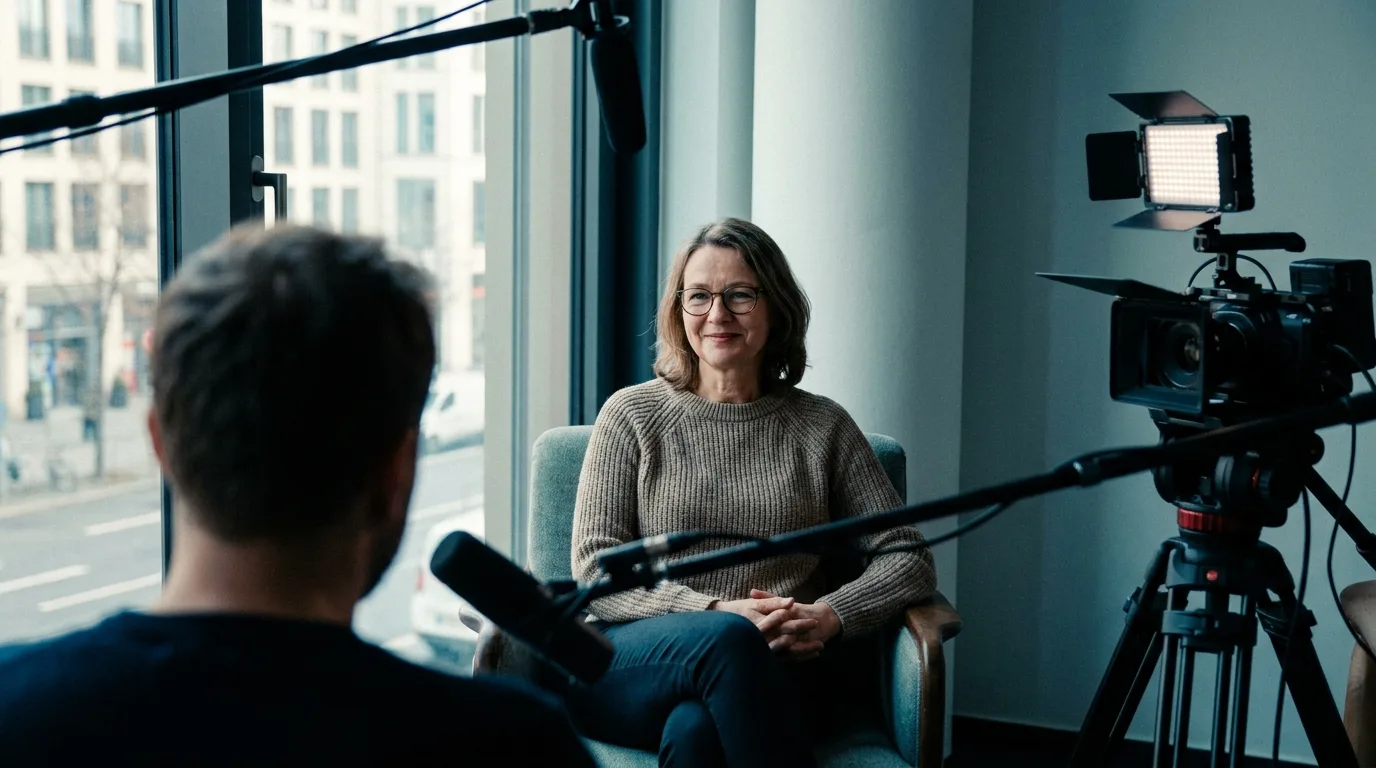
Documentary-style interview with an employee (stock image, AI-generated)
The 6 Cost Factors in Documentary-Style Brand Films
1. Shooting Time and Proximity
Authentic moments can’t be scheduled—you have to be there when they happen. Two days of filming are the minimum for a brand portrait; a brand story requires several filming phases spaced apart so that its evolution becomes visible. In documentary work, time is the price of authenticity.
2. Protagonists Instead of Actors
There are no actor’s fees—but there is a lot of work involved that is often underestimated: finding protagonists, building trust, and conducting interviews that yield more than just memorized lines. Good interviewing is a craft and the heart of the genre.
3. Editing Structure Using Actual Footage
In a scripted film, the story is finalized before shooting begins. In documentary filmmaking, the story takes shape during editing—10 to 20 hours of footage are condensed into a 4-minute film. This dramaturgical process is the single largest cost factor and the reason why cheap “documentary” productions usually deliver nothing more than a string of raw audio clips strung together.
4. Team Size
In documentary filmmaking, “small” and “flexible” mean having just two or three people on set instead of a ten-person crew with a lighting truck. This saves money compared to large-scale productions—but shifts the effort to experience: A documentary DP must decide in seconds what a planned production takes hours to set up.
5. Music and Licenses
Music carries more emotional weight in documentary films than in commercials—so licensing should be handled with corresponding care. Plan to allocate 3 to 8 percent of the budget for music, sound design, and cinema-quality color correction.
6. Service Life and Derivatives
A brand film that lasts three to five years—and from which employee testimonials, social media formats, and trade show versions are derived—is costed differently than a standalone video. Make sure to clarify in the proposal which derivative content is included—this is the real factor that determines the cost per contact.
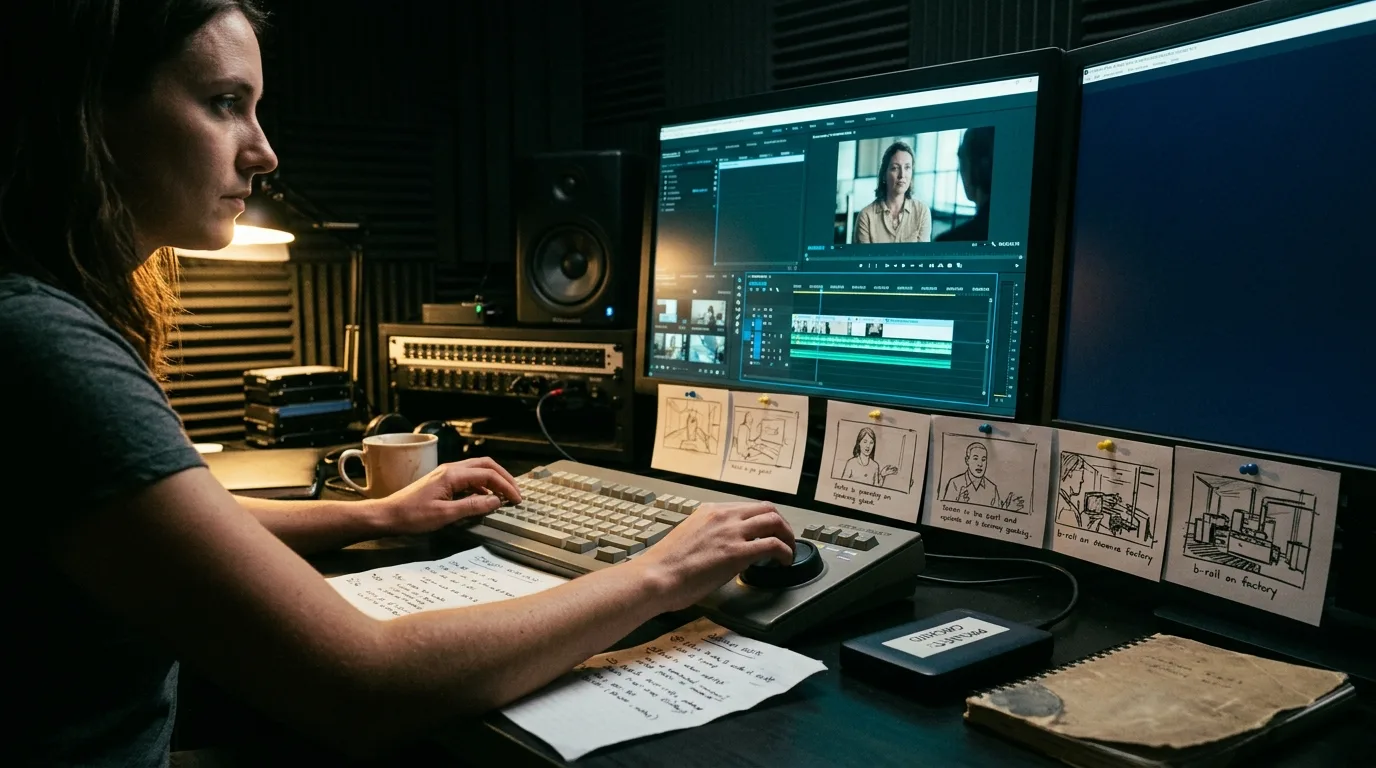
Editing a documentary-style brand film (stock image, AI-generated)
Sample Calculation: How much does a brand video cost per year—and per contact?
The purchase price is the wrong metric—what matters is how much a minute of impact costs. Here’s a concrete example: A brand profile costing 12,000 euros, which runs for four years on the website, during sales meetings, at two trade shows per year, and in recruiting, costs 3,000 euros per year. If it reaches only 20,000 relevant contacts during that time—a conservative estimate for a medium-sized company with a functional website and trade show presence—the cost per qualified contact is 60 cents.
By way of comparison: A low-cost 4,000-euro video that looks embarrassing after twelve months and needs to be replaced costs 4,000 euros per year—plus the cost of replacement, plus the hidden damage that a poor video causes with every single interaction. When it comes to brand presence, cutting corners on production almost always ends up costing more in the long run. Incidentally, the same logic applies even more strongly to recruiting: We calculate the cost of a vacant position per month using our recruiting video ROI calculator.
Rule of thumb: Divide the cost of each option by its realistic lifespan in years and the expected number of impressions. A documentary-style brand film almost always comes out on top in this calculation—not because it’s cheaper, but because its impact lasts longer.
How to Spot a Legitimate Offer: 7 Checkpoints
“Documentary” has become a buzzword—often it just means: We didn’t write a script. These seven points distinguish genuine documentary work from rebranded run-of-the-mill fare:
- Shooting Time Ratio: Is there enough shooting time available to wait for genuine moments—or is everything crammed into a tightly scheduled day?
- Editing effort disclosed: Creating a narrative from raw footage takes weeks, not days. An honest quote reflects that.
- Interview Skills: Who conducts the interviews, and what experience do they have? Ask for examples involving inexperienced participants.
- Brand Positioning Before the Shoot Schedule: Does the process start with your brand—or directly with dates and equipment lists?
- Examples within the genre: Does the portfolio show real people in real situations—or just glossy images with a voice-over?
- Consent Procedures: A reputable provider will handle the process of obtaining written consent from your employees—including addressing what happens when an employee leaves the company.
- Derivatives defined: Which versions, formats, and usage rights are included? This is exactly where the additional costs will crop up later.
These considerations apply regardless of whether you’re talking to us or another provider—they protect your budget from the most expensive option of all: a film that, in the end, no one wants to show.
How a Documentary-Style Brand Film Is Made: Process and Timeline
- Weeks 1–2 — Resonance Discussion & Brand Positioning: What should the film evoke in whom? What evidence does your brand have to support this?
- Weeks 2–3 — Research & Key Players: We identify the people and situations where your brand comes to life—within the company, not just on paper.
- Weeks 4–6 — Filming phase(s): Observational camera work, guided interviews, real-life work. For the brand story: several phases spanning several months.
- Weeks 6–9 — Dramatic editing: The story is identified in the footage, refined, and evaluated against the brand positioning.
- Weeks 9–10 — Final Touches & Edits: Color correction, sound, music, channel edits, delivery.
Realistic estimate: 6 to 10 weeks for a brand portrait, 3 to 5 months for a brand story. As a film production company based in Wiesbaden and operating primarily in the Rhine-Main region—from Frankfurt to Mainz—we can schedule shooting phases flexibly without every trip becoming a cost factor.
Who stands to benefit from this—and who doesn’t?
A documentary-style brand film is a worthwhile investment for companies whose value lies in their people, values, or craftsmanship: mid-sized companies competing for skilled workers, family-owned businesses with a rich history, B2B brands whose services require explanation, and organizations undergoing mergers or transformation. In all these cases, evidence speaks louder than claims.
Three typical scenarios from our practice: A mechanical engineering firm loses job applicants to large corporations with bigger marketing budgets—and wins them back when real colleagues, rather than marketing slogans, talk about their day-to-day work. A family-owned business facing succession wants to preserve what the founding generation has built while they’re still able to share their stories. An IT service provider sells trust but can’t demonstrate it in sales pitches—the video takes care of that before the sales team enters the room.
It’s not the right tool if you want to promote a product with a clear call to action—that’s what a promotional video is for (prices in the Promotional Video Cost Guide)—or if your budget is under 10,000 euros: In that case, a focused, authentically produced image film is a better investment than a half-hearted documentary.
Frequently Asked Questions About Documentary-Style Brand Films
How much does a brand film cost?
A documentary-style brand film starts at 12,000 euros (brand portrait), while more extensive productions involving multiple shooting phases start at 22,000 euros (brand story). Generic “brand film” offers on the market range from 5,000 to 30,000 euros—most of which are traditional image films.
What is the difference between a corporate video and a brand video?
A promotional video represents the company for a specific occasion—a brand film builds the brand over the long term. Produced in a documentary style, it replaces assertions with evidence: real people, real work, and real progress instead of staged messages.
Is a documentary film less expensive than a scripted film?
To some extent. There are no actors, set construction, or large crews—but filming time and editing effort increase significantly. The bottom line is that a high-quality documentary-style brand film is on par with a well-produced corporate image film, but it leaves a more lasting impression.
How long can you use a branded video?
Three to five years is a realistic timeframe because documentary imagery ages more slowly than advertising aesthetics. Trends come and go—but real people doing real work remain credible. Individual employee testimonials are replaced when people leave the company.
Do we need a script?
No—but a clear brand position and a narrative plan. Instead of a screenplay, we create a treatment: Who are the protagonists, what situations do we follow, what questions do we ask? Reality provides the specific lines.
What if our employees don’t want to be on camera?
That’s normal—and it can be resolved. Documentary filmmaking means small teams, no floodlights, and interviews conducted as conversations. After 15 years, we know how to help people overcome their camera shyness in just a few minutes. Participation is always voluntary—that’s also the only legally sound approach.
How long does production take?
A brand profile: 6 to 10 weeks. A brand story: 3 to 5 months, because genuine development takes time. The brand universe evolves continuously on a quarterly basis.
Can we start small and expand later?
Yes—that’s exactly what these packages are designed for. The brand portrait is structured in such a way that the visual language, protagonists, and footage can later evolve into the brand’s story or brand universe. You don’t pay twice for anything: What’s filmed today can still be used tomorrow.
Conclusion: Invest in evidence, not in claims
A documentary-style brand film starts at 12,000 euros—and differs from a traditional corporate image film less in price than in what you get in return: not just another video that claims to be credible, but a film that proves it. Those who think bigger build a cinematic foundation through brand history or a brand universe that will last for years and make every subsequent production more cost-effective.
You can find an overview of all our services here—from corporate videos to recruitment productions, such as those for Boehringer Ingelheim, to ongoing brand support.
And if you’re still unsure which tool is right for your situation, that’s exactly what the initial consultation is for. We’ll give you an honest assessment of what’s right for you, even if the answer is “a classic corporate video” or “not a video at all yet”—after 15 years in Wiesbaden and over 1,000 productions, we can afford to be that honest.
What story does your brand tell?
Free Consultation — we’ll listen to you, ask the right questions, and give you honest advice on which package is best suited to your situation.