
Video in Change Communication: Usage, Formats, and Costs in 2026
Why Transformations Fail Because of Communication — and How Town Halls, Leadership Statements, and Employee Voices Build Buy-In.
Reading time: 11 minutes | Updated: July 2026
Most transformation projects don’t fail because of the strategy—they fail because people don’t buy into them. Restructuring, digitalization, site consolidation, new software, new leadership: What looks coherent in the executive board’s presentation comes across to the rank and file as rumors, office gossip, and uncertainty. The traditional tools of internal communication—mass emails, intranet announcements, and a cascade of slides passed down through management levels—lose their tone, context, and credibility with every step they’re forwarded.
This is exactly where video comes in: It conveys the message authentically—through facial expressions, voice, and body language—to every location, every shift, as often as necessary. Among other projects, we produced a change management video for the Hessian Ministry of Finance that supported an administrative transformation for approximately 5,000 employees—in coordination with the staff council. This guide is based on that experience: it explains which video formats are effective in change management, what they cost, and what corporations and government agencies need to keep in mind.
The short answer: Here’s how much Change videos will cost in 2026
In 2026, videos for change communication will cost between 1,500 and 20,000 euros per module. A documentary-style executive statement costs between 1,500 and 3,500 euros; a town hall recording with a multi-camera setup starts at 4,500 euros. A series of employee testimonials with three to five episodes costs 4,000 to 8,000 euros, while an animated explainer video on change costs 1,500 to 15,000 euros. A documentary-style change film that chronicles a transformation as a whole ranges from 8,000 to 20,000 euros.
Why Video Works in Change Where Slides Fail
Change first raises questions, then fears, then rumors—in that order, and faster than any cascading communication can keep up. Three characteristics make video the most effective tool for change communication:
- Authenticity: When the CEO herself explains why something is changing, that’s exactly what comes across—not the interpretation of third-level management. Tone of voice, hesitation, sincerity: None of that comes across in a PDF.
- Reach and Simultaneity: Production, Administration, Field Service, Night Shift — Video reaches everyone with the same message, regardless of location or shift. With 5,000 employees, this simply wouldn’t be feasible any other way.
- Repeatability: Change messages need to be heard multiple times before they take effect. A video can be shown during a team meeting, viewed on the intranet, and reused during onboarding—the same message, always with the same quality.
The fourth point is the most important—and the most underestimated: Video can not only inform employees, but also demonstrate. When employees see colleagues in a video who are already embracing the change, they don’t experience it as an order from above, but as something that people just like themselves are driving. This is the key to acceptance, a theme that will recur throughout this article.
The Five Video Formats for Change Communication
“We need a change video” is rarely the right request—most of the time, you need two or three coordinated formats for different tasks and phases. These five have proven effective in practice:
1. Town Hall Recording and Live Broadcast
The all-hands meeting is the classic moment for announcing change—but it only reaches those who are physically present in the room. A professional multi-camera recording or live stream turns it into an event for the entire organization, including a Q&A session. Starting at 4,500 euros; our Live Streaming Cost Guide breaks down the details of streaming costs. Important: Have the recording edited into clips organized by section afterward—the five-minute answer to the most important question will be watched more often than the 90-minute full recording.
2. Executive Statements — Documentary Style Instead of a Teleprompter
A board statement read off a bookshelf is the most overused and least effective format in internal communication. We film executives in a documentary style: in conversation rather than giving a speech, on location rather than in a studio, with genuine answers to genuine questions. This costs hardly any more (1,500 to 3,500 euros per statement; cheaper as a series)—but it has a fundamentally different impact: People believe other people, not official statements. The difference lies in how the interview is conducted, not in the technology.

Documentary-style executive statement (stock image, AI-generated)
3. Employee Feedback — The Key to Acceptance
The most effective change format of all: short documentary-style episodes in which employees themselves share their stories—what’s changing for them, what made them skeptical, and what’s now working. These voices achieve what no management communication can: they turn those affected into active participants and give the change a human face from within their own ranks. A series of three to five episodes costs 4,000 to 8,000 euros. The key factors are voluntary participation and an interview style that allows for nuanced perspectives—more on that below.
4. The Animated “Change” Explanatory Video
When the change involves a complex system—new processes, new software, a new organizational structure—an animated video explains the technical aspects better than any live-action shoot: 1,500 to 15,000 euros depending on style and length; details are available in the Explainer Video Cost Guide. Our 2D animation for DVAG shows what this can look like. The best combination: animation for the “what” and “how,” and real people for the “why.”
5. The Documentary Film About Change
The key medium for major transformations: a film that tells the story of change—where the organization comes from, why it’s evolving, and where it’s headed—and tells the stories of the people who drive it. It serves as a reference point for all subsequent communication efforts and works just as effectively at town hall meetings as it does during the onboarding of new employees. Budget: 8,000 to 20,000 euros, depending on locations, shooting days, and the scope of interviews. Technically, it’s similar to a documentary-style promotional film —except that it doesn’t show the organization in its best light, but rather in the midst of an honest transition.
Change-Video Costs at a Glance: The Price Table
The typical components of video-based change communication in 2026:
| Format | Budget | Typical Scope |
|---|---|---|
| Executive Statement (documentary) | €1,500–3,500 | On-site interview shoot, 2–4 min., subtitles for audio-off use |
| Change Explanatory Video (Animated) | €1,500–15,000 | 60–120 sec., process/structure/system change explained in an easy-to-understand way |
| Town Hall Recording / Streaming | Starting at €4,500 | Multi-camera, audio for Q&A, followed by chapter clips |
| Employee Testimonials Series (3–5 episodes) | €4,000–8,000 | 60–120 seconds each, documentary-style interviews, intranet formats |
| Documentary Film on Change | €8,000–20,000 | 3–5-minute feature film, multiple locations/interviews, short versions |
| Change Management Support Over 12+ Months | Customized | A series of statements, episodes, and milestone videos covering the various phases of change |
More Cost Guides: Promotional Video Costs · Advertising Video Costs · Drone Footage Costs
How much will your project cost, specifically?
Tell us briefly what you have in mind—during the free initial consultation, you’ll receive an honest assessment with no obligation.
All prices are net and are approximate.
Case Study: Change Film for the Hessian Ministry of Finance
In 2022, we produced a change film for the Hessian Ministry of Finance that supported an administrative transformation for approximately 5,000 employees of the state’s financial administration. What made this project unique: a government agency structure with long-established processes, a workforce that was understandably highly sensitive to signs of change—and a staff council that was involved from the very beginning and actively supported the project. The film featured real voices from within the administration rather than a dramatic voice-over and was distributed widely through internal channels.
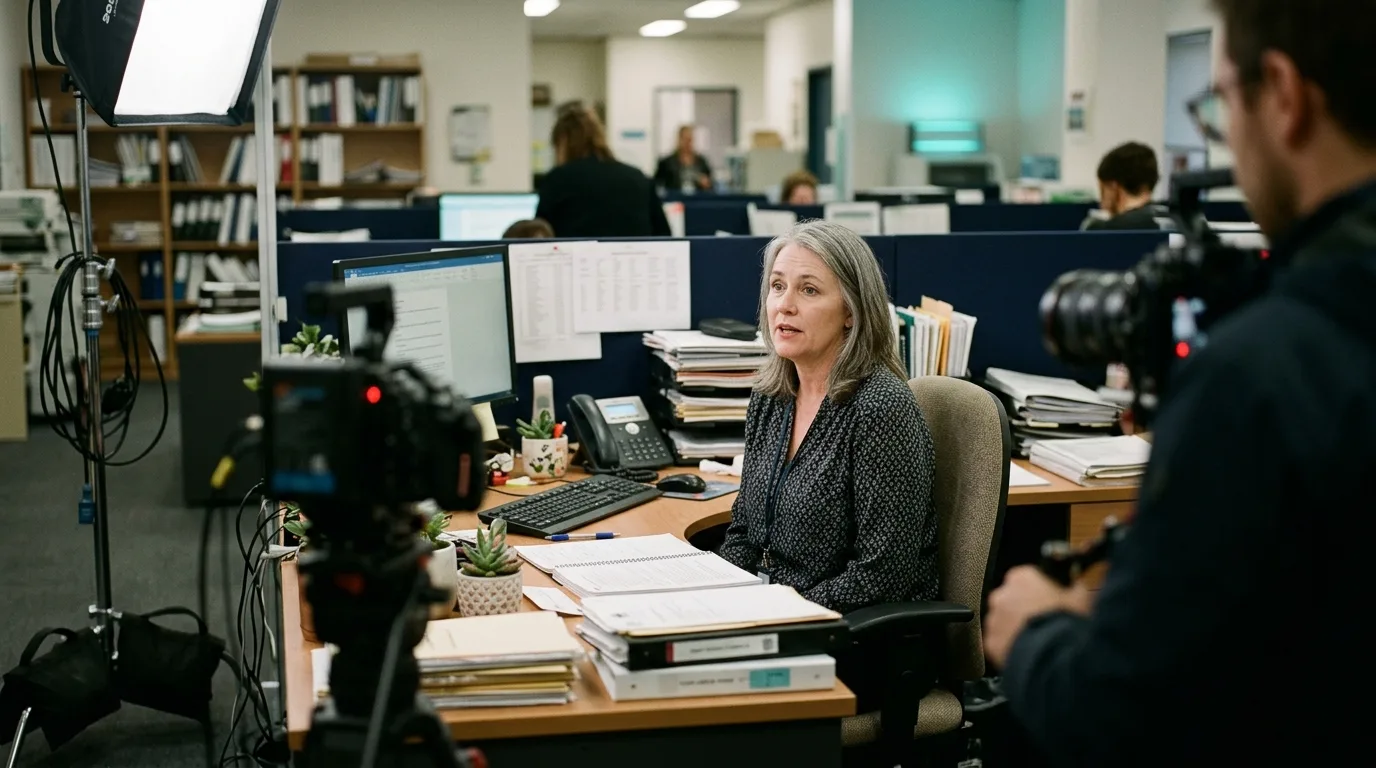
Employee Voices: Change Interview (stock image, AI-generated)
The three most important lessons from this project apply to any large organization: First, involving employee representatives early on is key to success—not as a formality at the end, but as partners from the concept stage onward. Second, internal films require a different visual language than marketing films: more understated, closer to the reality of the workplace, and free of the glossy advertising style that is immediately perceived as insincere within the organization. And third: The people in the film must be met where they are—skepticism is allowed; otherwise, no one will believe the rest.
Government Agencies and Corporations: Staff Council, Data Protection, Intranet
In-house video production in large organizations has its own set of rules—knowing them can save you months:
- Involve employee representatives early on: The staff council or works council should be familiar with the video concept before the first camera starts rolling. Our experience shows that if you win over these bodies as allies, you’ll not only get their approval but often also secure the most credible participants.
- Documenting Voluntary Participation: Employees appearing on camera need to provide informed, voluntary, and revocable consent—clearly worded in accordance with labor law, not hidden as a blanket clause in their employment contract. We provide tried-and-true templates.
- Distribution Behind the Firewall: Intranet, internal video portal, secure streaming environment — Change videos containing sensitive content must not be posted on YouTube. Clarify resolutions, formats, and player compatibility with your IT department in advance.
- Confidentiality in the Production Process: During restructuring, the content of a film often involves stock market or personnel matters. Non-disclosure agreements for the film crew and tiered approval workflows are standard practice.
The 5 Cost Factors for Change Videos
1. The Format Mix
It’s rare that just one video is enough. A typical change campaign combines a main film, statements, and short segments—and is significantly more cost-effective when planned as a package: shared shooting days, one team, and a consistent visual style. Videos ordered individually end up costing 30 to 50 percent more overall than a series planned from the start.
2. Locations and Shooting Days
Change usually involves multiple locations—and that’s precisely where credibility comes in: The film must show the factory floor in Kassel just as much as the headquarters in Frankfurt. Each location requires a day of filming, along with the associated logistics. Cost savings can be achieved through smart cluster shoots, not by omitting locations.
3. Number and depth of the interviews
Documentary interviews take time—realistically, 60 to 90 minutes of conversation per person for 90 good seconds in the film. This time is the core of the budget and the worst place to cut: rushed interviews produce stilted statements that no one believes.
4. Approval and Confidentiality Workflows
Internal videos go through more approval stages than marketing videos: Communications, HR, Legal, Employee Representation, and the Executive Board. Each round of revisions takes time. This can be planned effectively with a clear approval timeline—which we define at the kickoff meeting, not when a conflict arises.
5. Ability to update during the change cycle
Transformations take years; videos become outdated in a matter of months. Those who structure production as a series with a reusable framework—intro, visual style, musical theme—can produce milestone updates for a fraction of the cost of the first film. This series-based approach belongs in the first call for proposals, not the second.
Dramaturgy: Turning Victims into Participants
The most common mistake in change videos is well-intentioned: presenting everything in a positive light. But a workforce that is currently experiencing changes in its day-to-day work immediately recognizes whitewashing—and extends that mistrust from the video to the entire project. Documentary-style change communication works differently: it gives voice to skepticism (“To be honest, I was against it”), shows the path forward (“What changed my mind was…”), and sticks to verifiable statements rather than vague visions of the future. This honesty isn’t a risk—it’s the prerequisite for impact: Only when the critical voice is heard in the film will viewers also believe the optimistic one. Technically, this is the same documentary approach we use to produce recruitment videos —such as the employee stories for Boehringer Ingelheim: real people, genuine statements, no memorized lines. In change management, this is doubly true because the audience knows the truth—after all, they work there.
Timeline: Video Showing the Phases of Change
- Phase 1 — Announcement: Town hall (recorded/streamed) plus a statement from senior leadership explaining the rationale. This is where the tone of the entire project is set.
- Phase 2 — Implementation: Explanatory videos covering technical aspects (new processes, systems), initial employee feedback from pilot areas. Production is underway in parallel with the rollout.
- Phase 3 — Consolidation: The documentary-style change film as a review and outlook, milestone episodes, and use in onboarding new employees.
From a production standpoint, individual segments can be delivered in three to six weeks, while a complete change film takes one to four months—mainly due to the approval cycles. The most important timing tip: Commission the first video before the announcement, not after. Once rumors start circulating, the video will be communicating after the fact rather than in advance.
The Four Most Common Mistakes — and What They Cost
Mistake 1: The video comes after the rumors
If employees find out about the restructuring from the newspaper or through the grapevine, even the best video can only do so much to repair the damage. Communication and production planning must take place before the announcement—even if that means producing the video under conditions of confidentiality.
Mistake 2: Marketing Aesthetics for an Internal Audience
Drone shots, epic music, glossy slow motion—what works in customer marketing triggers resistance internally: “So that’s what the money’s for.” Internal videos need a more modest, down-to-earth visual style. That’s also more cost-effective, by the way.
Mistake 3: Only the guide speaks
A change film featuring only members of the executive board reinforces exactly the feeling it’s meant to evoke: that decisions are being made over employees’ heads. The rule of thumb from our experience: at least half of the speaking time should be allocated to employees.
Mistake 4: Create Once, Never Update
A single video to announce the change, followed by radio silence—that signals the communication was just a formality. Change communication is a series. If you plan it that way, you keep the cost per episode low and attention high.
Hidden costs you should know about
- Subtitles and Accessibility — Internal videos are often watched without sound; subtitles are required, and government agencies must also take accessibility requirements (BFSG/BITV) into account
- Multilingual versions — international workforces need at least English subtitles: 300 to 800 euros per language version
- Formats suitable for the intranet — some internal players have their own codec and size requirements; factor in conversion and testing
- Revision cycles — for in-house films, more than two rounds of revisions are the norm; clarify the conditions for additional cycles in advance
- Music licenses for internal use — intranet use also requires a license; have an unlimited internal term specified in the offer
Frequently Asked Questions About Video in Change Communication
How much does a video for internal change communication cost?
Individual components starting at 1,500 euros (executive statements); complete documentary films on change range from 8,000 to 20,000 euros. A video series spanning several months, featuring statements, episodes, and milestone videos, is priced on a case-by-case basis—and is significantly more affordable as a package than as individual commissions.
Does the works council or staff council have to give its approval?
There is no general right to co-determination regarding the video itself—but footage of employees, references to behavior and performance, and the use of internal platforms raise issues related to co-determination and data protection. Our clear recommendation based on regulatory practice: Involve committees early on. This speeds up the project and improves the outcome.
Live-action or animated explainer video—which is better?
Both serve a purpose: Animation explains systems, processes, and structures (the “what”), while real people build trust and acceptance (the “why”). The most effective change campaigns combine both formats with consistent design.
How long should a “Change” video be?
Statements and episodes: 60 to 120 seconds. Explanatory videos: 60 to 90 seconds per topic. The main video: three to five minutes. Town hall recordings can be longer, but they need chapter markers and short clips for reuse.
Is it okay for the video to include criticism?
In fact, it should. A film that consists entirely of enthusiasm isn’t taken seriously by the audience. Skepticism—when taken seriously and addressed in the film—enhances the credibility of all other statements—that’s a fundamental principle of documentary filmmaking.
Can we also use the videos externally?
To some extent—and it’s worth it: A successful transformation is a compelling employer story. With additional consent, employer branding and recruiting content can be created using internal material. However, this must be accounted for in the consent forms and music licenses from the very beginning.
How many videos does a change campaign need?
At a minimum, this three-part approach has proven effective: a statement from leadership to announce the initiative, an explanatory video covering the facts, and a series of employee testimonials to illustrate the implementation. For transformations spanning several years, milestone episodes are added—planned as a series with a consistent visual style, so that each subsequent video costs less than the first.
How do you measure the impact of change videos?
Quantitatively, through intranet views, viewing time, and chapter skips; qualitatively, through pulse checks and sentiment surveys before and after publication. In our experience, the most practical indicator is the questions asked during team meetings after watching the video—they show whether the message has gotten through.
Conclusion: The smallest item in the change budget—with the greatest visibility
Transformation projects cost millions—consulting, systems, processes, training. Video communication for these projects costs a fraction of that: individual modules starting at 1,500 euros, and a complete video support package usually less than one percent of the project budget. By that measure, no other element of the change budget is as visible to so many people. Anyone who wants to communicate change seriously gives it a human face: that of the leadership team explaining the process—and that of the employees driving the change. It is precisely this combination that has proven effective, from medium-sized companies to state administrations with 5,000 employees. Our Corporate Video Cost Guide provides additional insight into what an accompanying corporate video might cost.
Our recommendation for getting started: Begin with the trio of executive statements, an explanatory video, and a series of employee testimonials—budgeted as a package, filmed with a consistent visual style, and planned to align with your change phases. And make sure to incorporate employee participation and data protection considerations before the first day of filming. Together, these two factors have a greater impact on the outcome than any camera.
Is your organization facing a change?
Free Initial Consultation — We’ll outline the right mix of formats for your change phases, including a roadmap for employee participation and data protection.